


Drawing insights from 460 accounting practices across Australia, Intuit Quickbook’s Growth and Marketing Maturity Benchmarking Report 2025 sheds light on the strategies and challenges set to shape the country’s accounting sector over the coming year.
Findings reveal that growth ambitions vary widely across the sector. At the same time, firms face a mix of internal and external pressures that are influencing how they plan for the year ahead.
Key stats you need to know
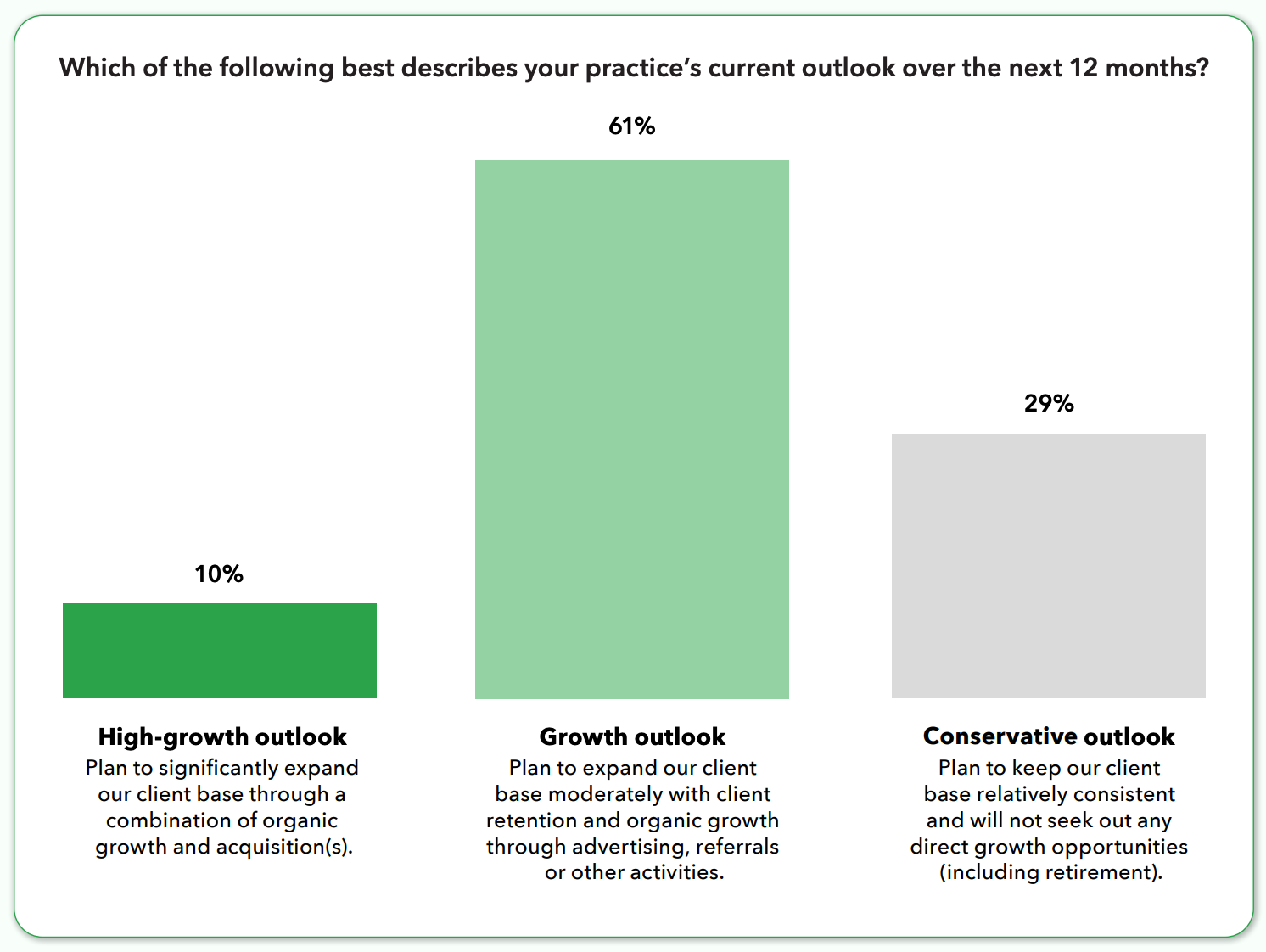
- More than six in ten (61%) accounting practices plan for moderate expansion in the next 12 months, while 10% target aggressive growth
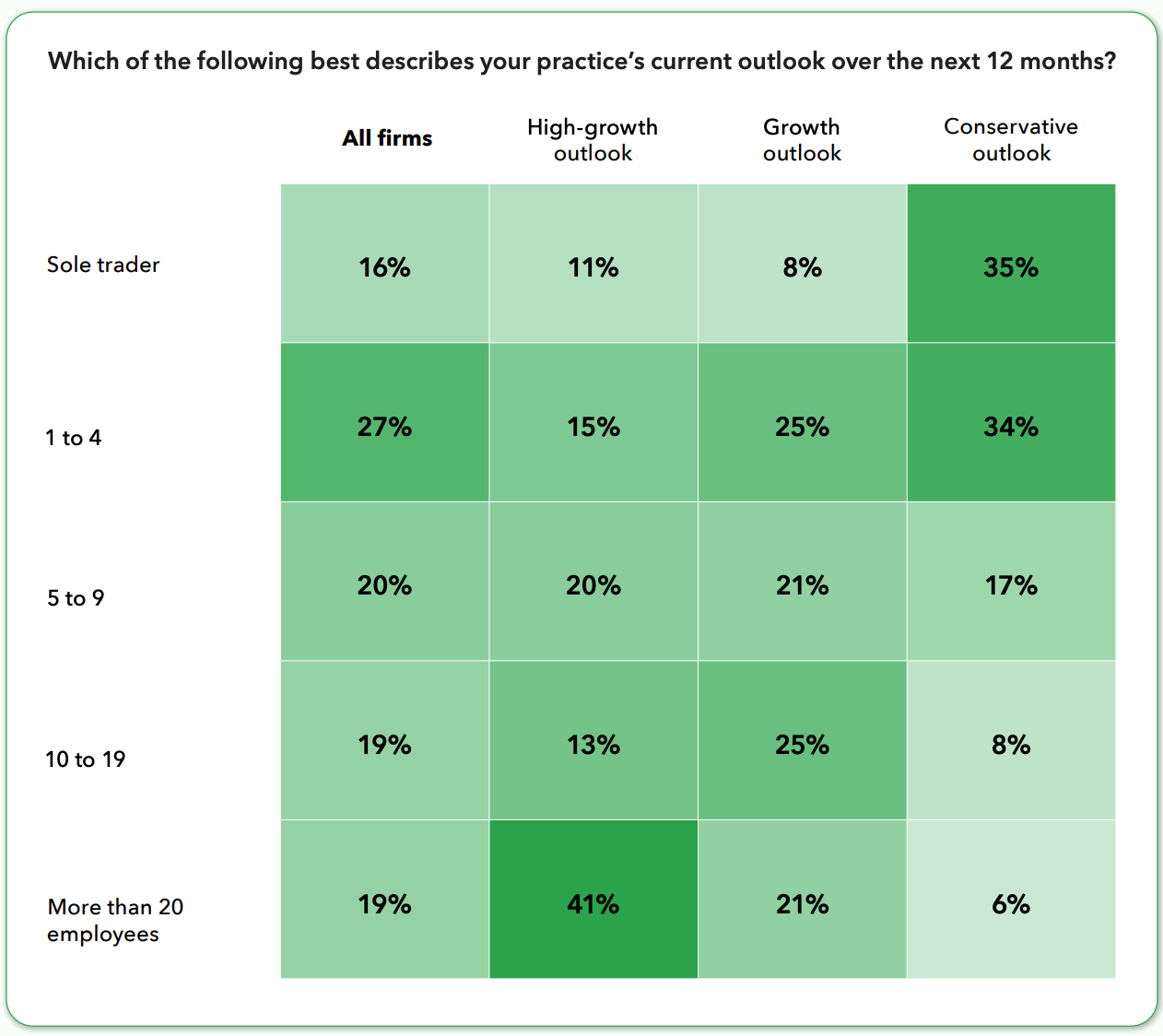
- 41% of high-growth outlook firms looking to expand their client base and grow capacity were large practices with 20 or more employees
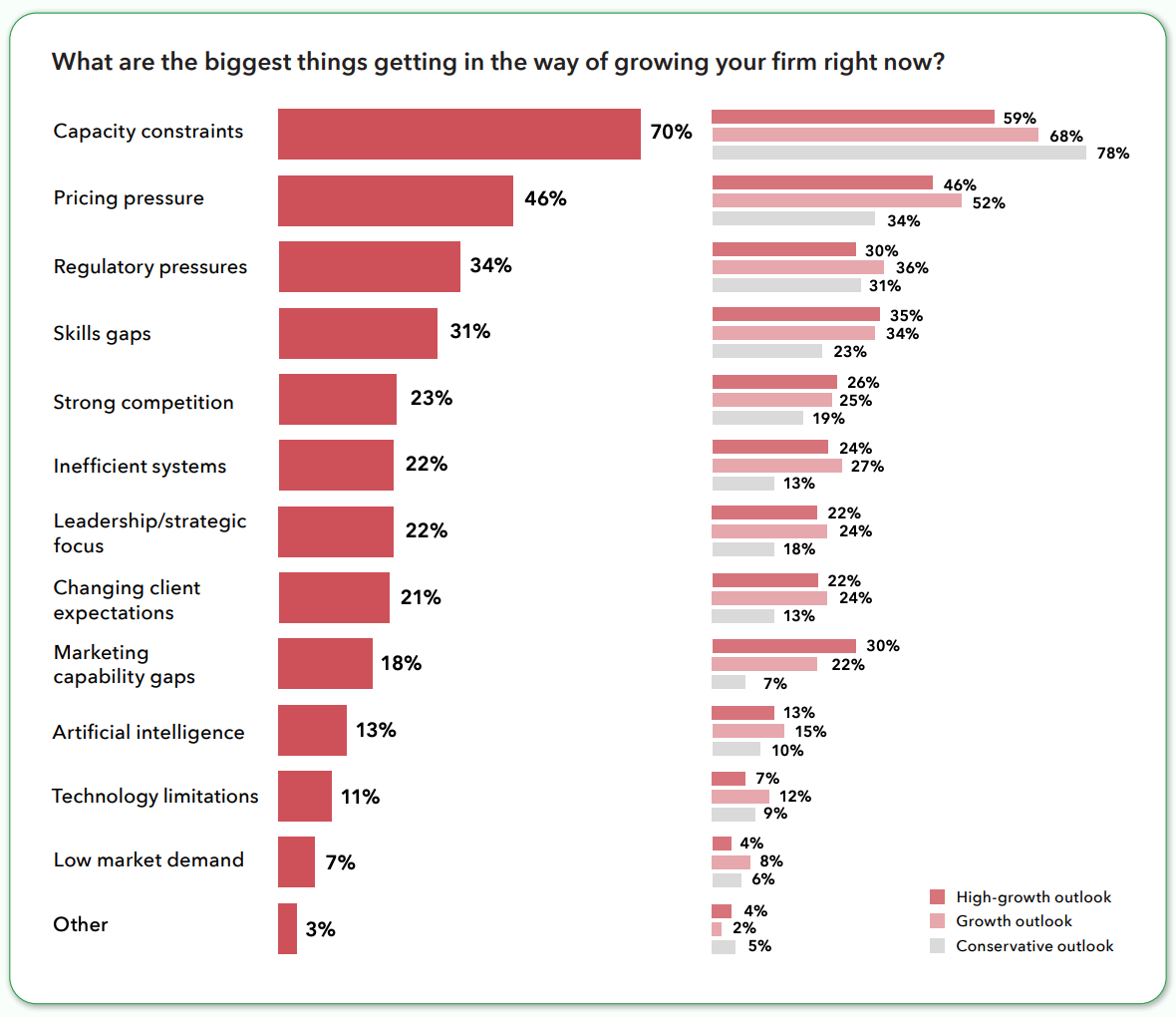
- Capacity constraints are the leading internal barrier to growth, cited by 70% of firms, followed by skills gaps at 31%
- Pricing pressures and regulatory burdens are the most pressing external challenges
7 in 10 firms plan for moderate to aggressive growth in their client base in the next 12 months
- Growth outlook firms to rely on client retention and organic growth while high-growth outlook firms also to pursue acquisitions
- 29% of firms take a more conservative outlook, choosing not to pursue expansion and, in some cases, preparing to wind down or retire their practices
Moderate-growth outlook firms focus on client retention and organic growth through advertising and referrals, while firms with an aggressive outlook combine these strategies with acquisitions to accelerate client growth. In contrast, 26% of firms take a more conservative approach, prioritising client retention and, while the remaining 3% are preparing to sell or leave the practice.
“The accounting sector is adapting to different growth outlooks. Moderate-growth firms aim to grow steadily, high-growth firms aim for rapid expansion through acquisitions, and conservative firms prioritise client retention and winding down when appropriate,” said Michael Johnson, Director at Agile Market Intelligence.
High-growth firms increase capacity in anticipation for client base expansion
- As high-growth firms pursue client expansion, 41% currently have 20 or more employees to support growth targets.
- Conservative-outlook firms are dominated by solo and small practices (69%).
- The connection between growth targets and organisation size suggests high-growth outlook firms invest in organisational infrastructure, in anticipation of growth.
Firms with an aggressive outlook tend to be larger firms, with 41% of them employing more than 20 people, while conservative-outlook firms are dominated by solo practitioners and small firms with up to four employees (69%). Moderate-growth firms fall in between, showing a more even distribution across firm sizes, highlighting that growth ambitions are closely linked to a firm’s capacity and workforce resources. High-growth firms recognise that expanding their client base requires a sufficiently-skilled and resourced team. Growth targets and workforce expansion appear to come hand-in-hand as anticipating client growth also means investing in organisational infrastructure.
“High-growth firms are invested in organisational infrastructure because scaling a client base requires both the right team and sufficient resources. Smaller practices, on the other hand, often take a cautious approach, focusing on stability and retaining their existing clients,” said Michael Johnson.
Perceived growth barriers vary by expansion outlook
- Capacity constraints is the leading barrier to growth according to 70% of all firms
- Pricing pressure felt by more than half (52%) of growth outlook firms
- Firms with a moderate-growth outlook tend to experience more growth challenges than both high-growth and conservative outlook firms
Capacity limitations remain the most significant internal barrier to growth across the sector. While 70% of all firms report being constrained, the issue is particularly more common for conservative-outlook practices, with 78% affected. High-growth outlook firms are also impacted, though to a lesser extent, with 59% noting capacity challenges.
Firms with a moderate growth outlook tend to experience the most growth challenges overall, including pricing and regulatory pressures, technology limitations, and inefficient systems. In contrast, high-growth outlook firms are more likely to identify skills gaps (35% vs 31% overall) and marketing capability gaps (30% vs 22%), emphasising the importance of building capacity in client acquisition and business development.
Regulatory pressures and compliance demands are felt across firms of all growth outlooks, prompting many to adopt in-house reviews and automated compliance solutions. To address pricing pressures, firms also leverage technology to reduce their costs while maintaining their service quality.
“Growth barriers differ depending on a firm’s outlook, conservative firms are often constrained by capacity, moderate-growth firms face a wide range of challenges, and high-growth firms are focusing on marketing and skills development. Understanding these differences is critical for firms looking to invest strategically in people, technology, and infrastructure,” said Michael Johnson.
About the research
Intuit Quickbook’s Growth and Marketing Maturity Benchmarking Report 2025 is based on quantitative research conducted by Agile Market Intelligence, reflecting the sentiments of 460 accounting practices across Australia, and collected between September and October 2025. The study provides a data-driven roadmap for accounting practices to accelerate growth by examining the behaviours, investments and strategic choices that distinguish high-growth firms.
You can download the report here.
Intuit Quickbooks is hosting The High-Growth Practice Benchmark, a data-driven discussion on Growth & Marketing Maturity Report. The session uncovers how top performers use the right strategies, systems and technology to achieve success.
Register for the webinar here.
