


The Access Group’s The State of AI in Accounting Report 2026 draws on insights from 434 accountants and bookkeepers across Australia to understand how the profession expects AI to impact their practice over the next two to three years.
Rather than replacing accountants, AI is expected to elevate their work by automating routine processes, improving accuracy, and freeing up time for giving higher-value advice and maintaining stronger client relationships. At the same time, practitioners are clear that trust, privacy, and ethical use will determine the pace and depth of adoption.
Key stats you need to know
- The majority (70%) of accountants and bookkeepers seek to offload repetitive tasks such as data entry, coding, and compliance work to AI in the next 2-3 years.
- Some envision AI to do fraud and anomaly detection and smart search for relevant laws and rules.
- Accountants want to maintain oversight and quality control over AI output.
- Data security and accuracy are perceived as key concerns for deeper AI integration.
AI to streamline routine work, freeing time for higher-value advice
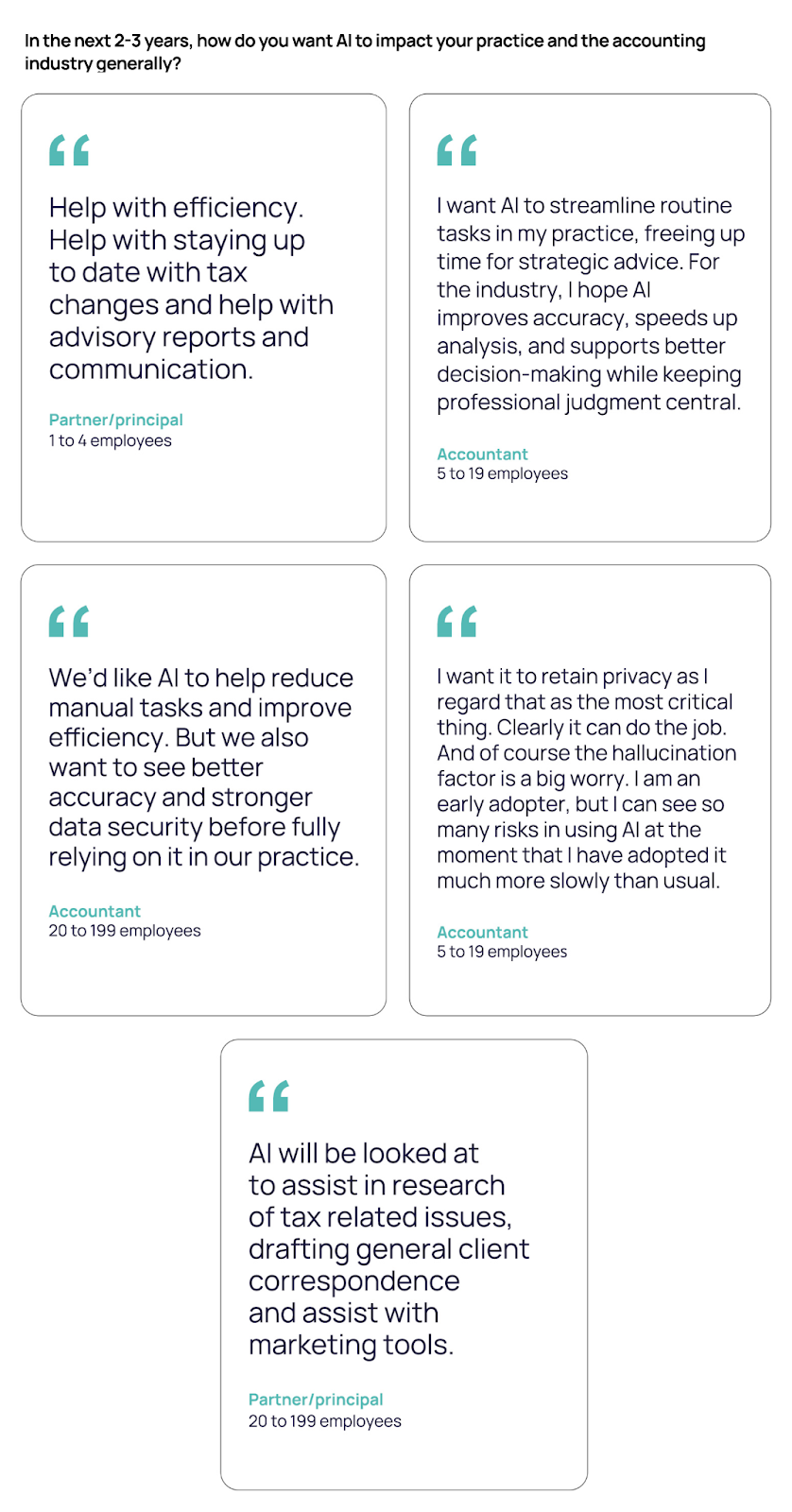
Practitioners want AI to reduce routine manual tasks so they can focus on giving strategic advice and improving client engagement. Research on laws and updates, report drafting and client correspondence emerge as key areas where AI can deliver immediate efficiency gains. As one partner at a large firm noted, “AI will be looked at to assist in research of tax-related issues, drafting general client correspondence and assisting with marketing tools.”
Over the next 2-3 years, practitioners expect AI to be a productivity multiplier, improving the speed and accuracy of their research, supporting advanced tasks such as fraud detection and financial and policy data analyses, while leaving interpretation and accountability with professionals.
“The goal in using AI is not less human involvement, but better use of human expertise,” says Michael Johnson, Director at Agile Market Intelligence. “AI should take care of the busywork so professionals can focus on insight, relationships, and decision-making.”
Safe and ethical use of AI remains non-negotiable
Sentiments from practitioners suggest a nuanced view of how AI can impact the industry 2-3 years from now, recognising its potential and limitations. Even early adopters highlight data privacy, security, and the risk of inaccurate outputs as reasons for cautious adoption.
As one accountant explains, “...Clearly it can do the job. And of course the hallucination factor is a big worry. I am an early adopter, but I can see so many risks in using AI at the moment that I have adopted it much more slowly than usual.”
Clear AI governance, transparency, and mechanisms for professional oversight are seen as essential to scaling AI use in accounting practices. “Accountants are excited about what AI can do, but they are not willing to trade trust for speed,” notes Michael Johnson. “Safe, ethical, and well-governed AI will be the difference between experimentation and full-scale adoption.”
About the research
The Access Group’s State of AI in Accounting Report 2026, conducted by Agile Market Intelligence, maps out AI adoption, risks and barriers holding back adoption, and the practical use cases already delivering value today. The report captures the sentiments of 434 accountants, bookkeepers and other accounting professionals across Australia around their experiences of artificial intelligence in their practice. Responses were collected between the 9th of September and the 13th of October 2025.
You can download the report here.
