


A new survey of 515 legal professionals reveals a sharp divide in how firms are adopting and managing artificial intelligence (AI). The study, Brand Intelligence: Law, asked respondents on whether they use AI for work, followed up by whether they have clear AI policies at their firm. The largest practices have moved quickly to channel AI usage through vetted platforms, smaller firms show a more diverse picture - mixing approved tools, personal initiatives and outright non-adoption. Larger practices also moved quickly to formalise AI governance. Agile Market Intelligence takes a look at AI adoption and policies in Australia’s legal practice today.
Key stats you need to know
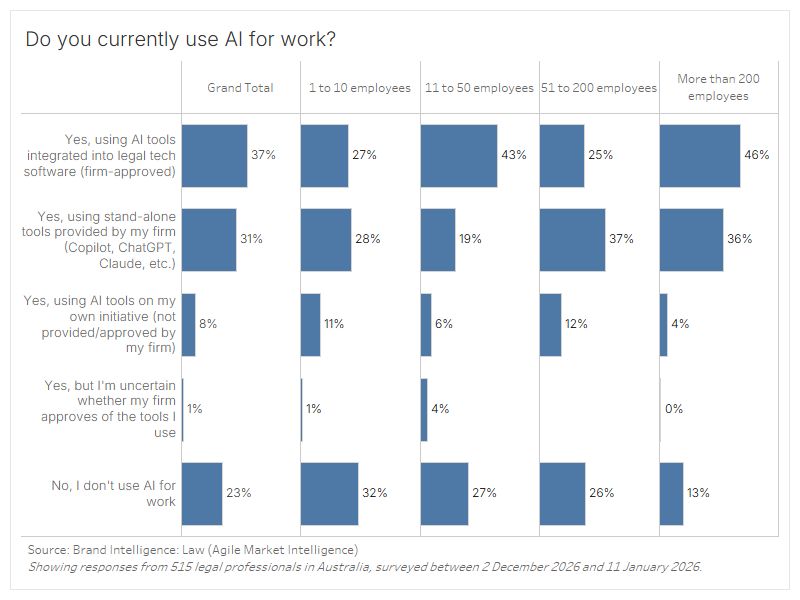
- 46% of legal professionals at firms with more than 200 employees are using AI tools integrated into firm-approved legal tech software, compared to just 27% at firms of 1 to 10 employees.
- 1 in 3 legal professionals in small firms (1 to 10 employees) report not using AI for work, while 11% admit to using AI tools on their own initiative without firm approval.
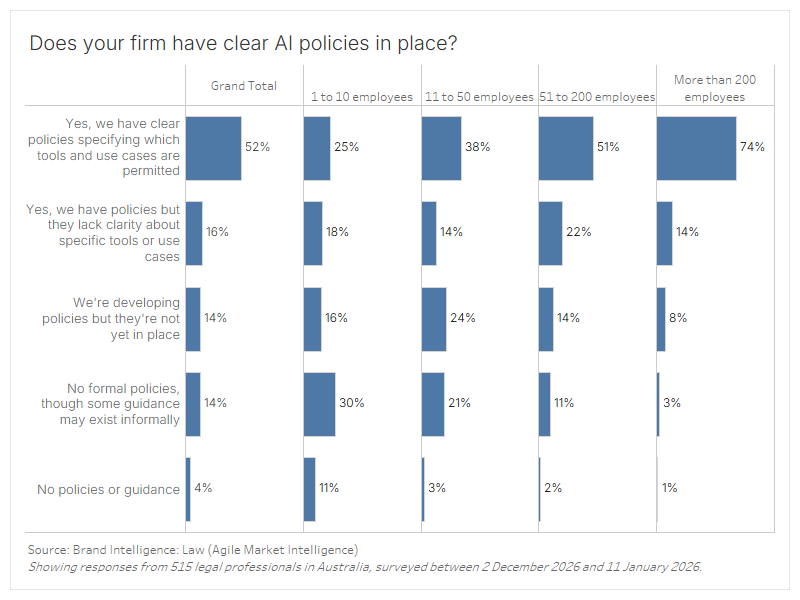
- 74% of ‘Big Law’ firms have clear AI use policies specifying which tools and use cases are permitted, compared to just 25% of small firms (1 to 10 employees).
AI usage is widespread, but adoption patterns differ by firm size
- 37% of legal professionals surveyed use AI tools integrated into legal tech software, while 31% primarily use standalone AI tools.
- 46% of firms with more than 200 employees use legal tech AI, more than their standalone AI adoption of 36%; for boutique firms with 11 to 50 employees, they’re twice more likely to use legal tech integrated AI (43% versus 19% for standalone)
- Small firms (1 to 10 employees) and midsize firms (51 to 200 employees) use more standalone AI tools than legal tech AI tools.
AI adoption is gaining traction in legal practices across Australia, with integrated AI tools having an edge over standalone AI in terms of adoption (37% vs 31% for standalone). When looking at the adoption of AI tools by org size, we see that this preference for integrated AI tools is only true for big law (more than 200 employees) and firms with 11 to 50 employees.
At present, the largest segment of users are the 46% of legal professionals in big law firms (with 200 or more employees) who use AI tools that are integrated into legal tech software that has been provided and approved for use by their firm. Standalone AI’s largest adopters are the 37% of firms sized 51 to 200. Small firms (1 to 10 employees) have the largest share of lawyers saying they don’t use AI at all (32%).
Large firms lead on AI governance, small firms catching up
- 74% of large firms (more than 200 employees) have implemented clear AI policies that specify which tools and use cases are permitted.
- The share of firms with AI policies in place scales with firm size. 51% for firms sized 51 to 200, 38% for firms sized 11 to 50 and 25% for small practices of 1 to 10 employees.
- Only small firms are left with 11% with no existing policies or guidance on AI use.
Over half of firms (52%) across Australia now have clear AI policies in place that define which tools and use cases are permitted in their practices. Another 16% have policies in place, but suffer from a lack of clarity. Leading the charge are large practices, with about 3 in 4 firms (74%) having clear AI policies in place, and with only 1% of those surveyed in Big Law saying they have no policies or guidelines in place.
Firms adopting AI use outpace firms with AI policies, underlining how rapidly these tools have moved from experimental to becoming part of daily workflows. The data also reflects capacity, rather than intent, where large firms have resources to draft, implement and enforce AI governance frameworks, and smaller practices are developing policies while usage normalises around them.
“AI governance isn’t optional anymore. At the rate AI adoption is going, firms of all sizes are going to feel the pressure to self-regulate. The risk isn’t just in compliance, but in the informal guidance that could become a liability when something goes wrong,” says Michael Johnson, Director at Agile Market Intelligence.
Corporate counsel falls behind on legal tech AI adoption and governance
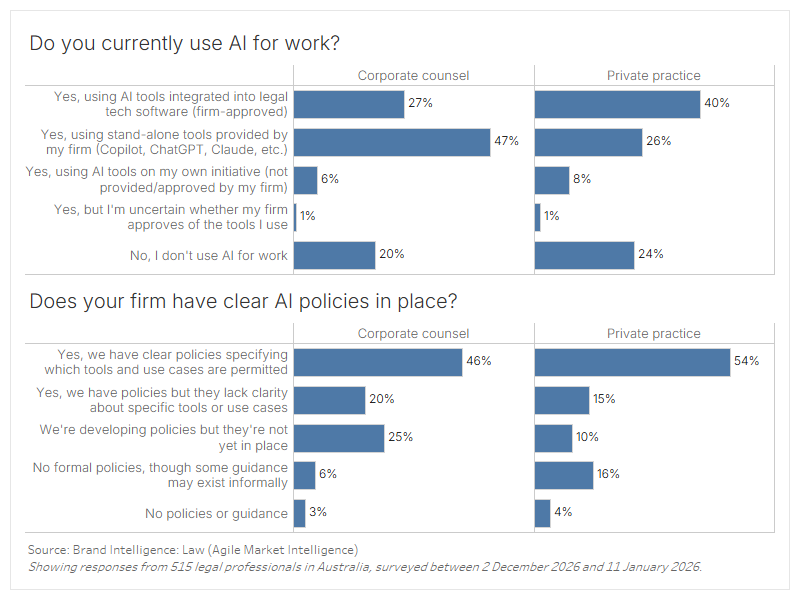
- Corporate counsel are more likely to be using standalone AI (47%) than legal tech integrated AI (27%) compared to private practice (only 26% for standalone versus 40% for legal tech AI).
- Private practice (54%) leads corporate counsel (46%) in AI governance.
Due to the nature of the corporate counsel practice, where legal departments are set apart from the core technology procurement and governance structures of their organisations, in-house lawyers face a different set of constraints than their private practice counterparts. Many rely on standalone AI tools (47%) rather than enterprise legal tech platforms (27%), while simultaneously operating with less formal policy frameworks despite being embedded in larger corporate environments. Notably however, slightly fewer corporate counsel report not using AI for work (20%) compared to private practice (24%).
“The 47% of corporate counsel using standalone AI tools signals a procurement disconnect. They might belong to large enterprises, but are left to rely on consumer-grade tools rather than legal-specific solutions,” added Michael Johnson.
About the research
Agile Market Intelligence’s Brand Intelligence measures brand performance through systematic tracking of awareness, consideration, and preference metrics across defined market segments. The research enables marketers to benchmark their brand against competitors, measure statistically significant shifts in market positioning, and track performance over time, while capturing on-demand insights.
This analysis draws on quantitative feedback from Australian legal professionals across the most recent Brand Intelligence: Law survey conducted between 2 December 2025 and 11 January 2026, capturing responses from 515 legal professionals in private practice (n=402) and corporate counsel (n=113). Respondents were asked about their AI use and existing firms' policies on AI.
