


April is a month in which households are reprioritising their finances due to the onslaught of events impacting the economy. From price hikes to discontinued government rebates, Australians are recovering from the costly previous month and looking towards growing their savings once more.
Capturing data from roughly 1,500 monthly respondents, Agile Market Intelligence’s Consumer Pulse survey monitors shifting financial priorities of Australian consumers, subdivided into those with consumer loans, those with home loans, and those who are debt-free.
Key stats you need to know
- 3 in 10 Australians are focused on day-to-day expenses this month.
- 27% of mortgage holders are prioritising savings, a 5% increase from the previous month.
- Nearly 2 in 5 consumer debt holders (38%) are focused on their savings over other financial concerns.
Australians prioritising daily expenses continues to rise
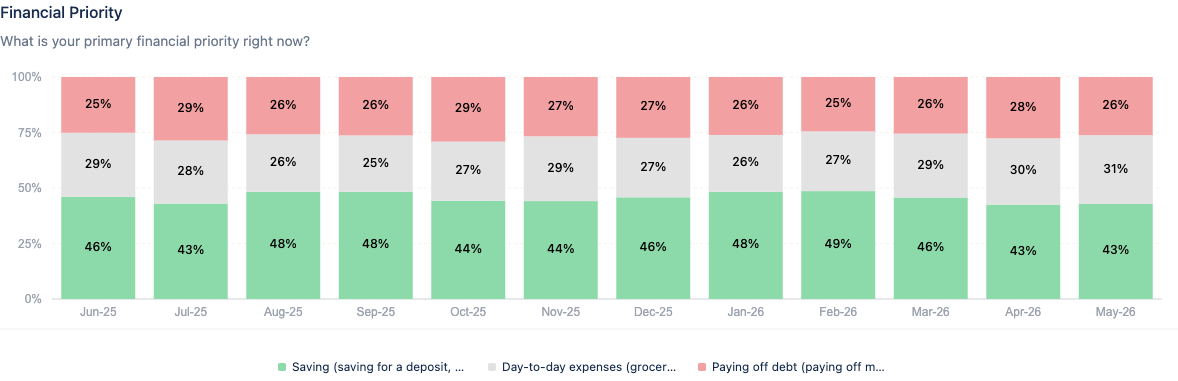
- Nearly 1 in 3 of the population is focusing on day-to-day expenses.
- Saving is still the financial priority for the largest segment (41%).
- 26% of Australians are prioritising paying off their debts.
The share of Australians prioritising day-to-day expenses (31%) has been steadily increasing since the start of the year, then at 26%. The cost of everyday goods and services is still rising in light of recent global conflicts. Additionally, the conclusion of the Australian government’s Energy Bill Relief Fund last December 2025 means that households started receiving energy bills without rebates last month.
“April was a costly month for Australians, and May is about recovering from such expenses,” says Michael Johnson, Director at Agile Market Intelligence.
“With price hikes due to conflicts across the globe and without any more energy rebates, Australians are more conscious about how they spend their money and where they put it.”
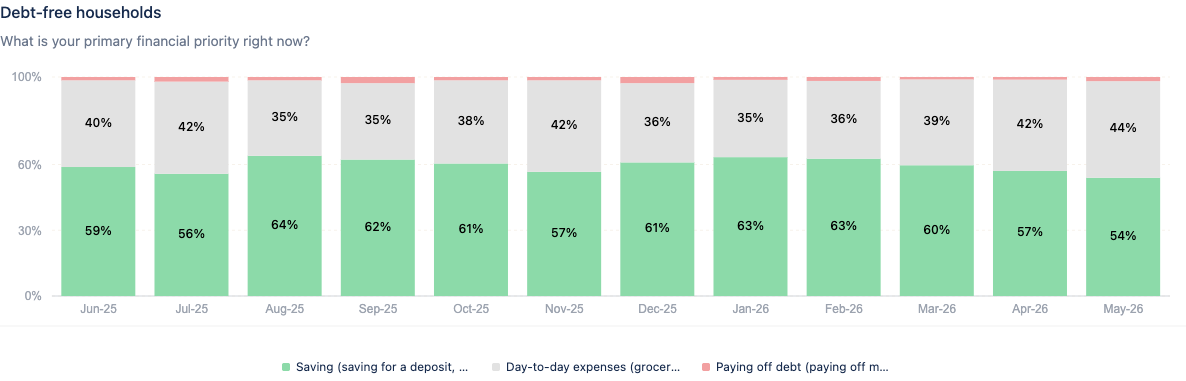
Debt-free Australians focusing on daily expenses rose by 9% since January
- 44% of debt-free Australians are concerned about their day-to-day expenses, a 9% increase from the start of the year.
- 54% of debt-free households prioritise savings in April, representing the largest segment of the population doing so.
Debt-free households represent the most financially stable cohort of the population. At the beginning of the year, 63% of this group reported prioritising savings, but this share has since reduced to 54%. As inflation continues to rise, even the debt-free are forced to pivot to prioritising their day-to-day expenses. At present, 44% of consumers are concerned about this in May, the highest recorded share of this segment over the past year.
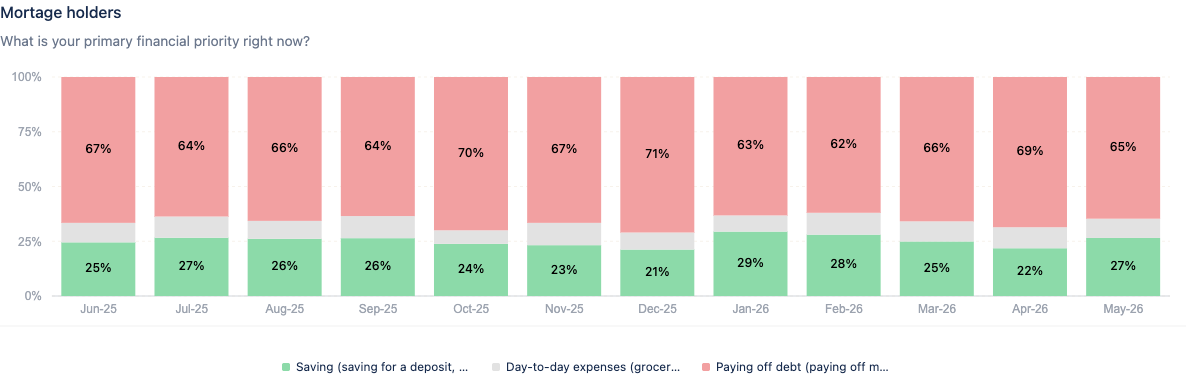
Mortgage holders continue to prioritise debt repayment
- The primary financial priority for mortgage holders continues to be paying off debt (65% of the cohort).
- 29% of mortgage holders, however, are focused on growing their savings, an increase of 7 percentage points from April 2026.
The main priority for mortgage holders remains to be debt settlement, it being a concern for 65% of the segment. By contrast, 29% of mortgage holders are focused on savings for May 2026, the second-highest priority for this group. The gradual increase in the prioritisation of debt repayment starting in February follows the news of cash rate increases that clearly caused concern for mortgage holders. May appears to show some relief, as the share has dropped by 4% from the previous month.
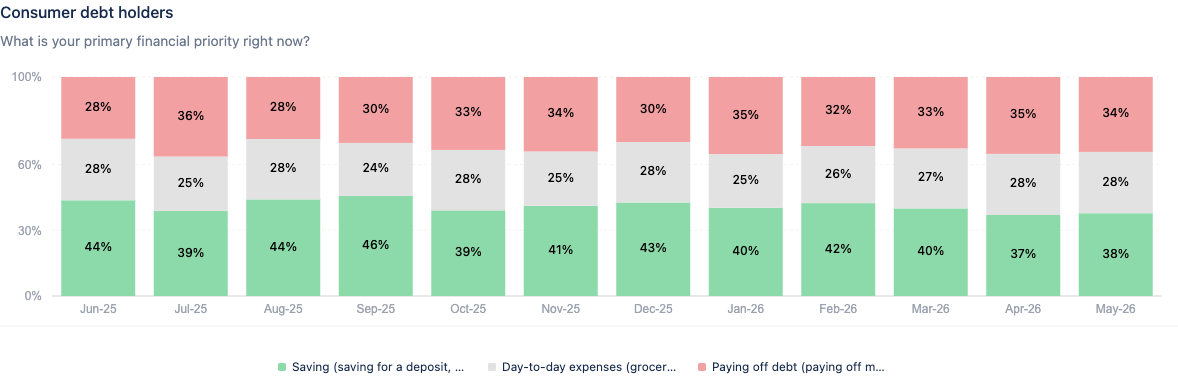
Savings is the priority for 38% of consumer debt holders
- Savings remains the highest priority for 38% of consumer debt holders.
- 34% of consumer debt holders are prioritising settling debts, the second-highest priority.
- Fewer are prioritising their day-to-day expenses, occupying 29% of this segment.
Consumer debt holders continue prioritising the setting aside of funds for savings (38% of the cohort), despite a slow decline from the start of the year (then 42%). The shift comes as the share of the cohort prioritising day-to-day expenses gradually increases, this month at 28%. Similar to debt-free households, the share of consumer debt holders prioritising day-to-day expenses is also the highest it has been over the past year.
About the research
This article is based on findings from Agile Market Intelligence’s Consumer Pulse survey, conducted from 1 June 2025 to 18 May 2026. Results were weighted to reflect national population profiles by age, gender, and state. Responses were collected from 17,787 Australian consumers, who were asked about their primary financial priority. Consumers were segmented based on whether they owned a mortgage, consumer debt, or none of either (“debt-free”).
The Consumer Pulse is a monthly tracker developed by Agile Market Intelligence to monitor consumer sentiment, financial stress, and behavioural shifts across key household segments. The survey gathers about 1,500 responses monthly, providing a real-time view of financial wellbeing in Australia, segmented by debt status, home ownership, and other demographics.
