


Agile Market Intelligence’s Consumer Pulse surveys around 1,500 Australian consumers monthly to monitor sentiment, financial stress, and behavioural shifts across key household segments. This survey tracks consumers’ financial priorities between savings, day-to-day expenses, and debts to pay. Across the various debt statuses, savings is the consistent priority for Australians in 2026 due to the recent interest rate fall back in December 2025. It remains to be seen, however, whether this trend continues after the RBA raised the cash rate by 0.25%.
Key stats you need to know
- Almost half (47%) of the Australian population is prioritising savings.
- 29% of mortgage holders view savings as their financial priority.
- 3 in 5 debt free Australians report savings as their main concern.
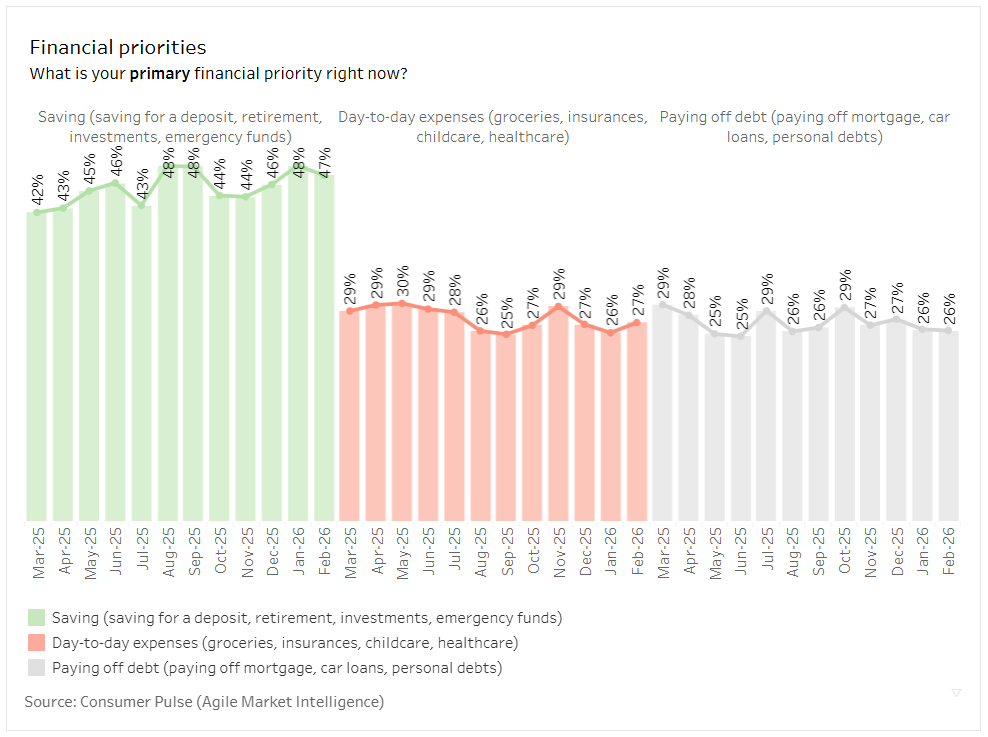
Nearly 1 in 2 Australians are setting aside funds for savings
- 47% of Australians view savings as their financial priority.
- Day-to-day expenses is the second highest priority, concerning 27% of the population.
- Australians are becoming less concerned about paying off their debts (26%).
Earlier in February, the RBA announced an increase in the cash rate target by 0.25 basis points to 3.85%. As of mid-February, savings remains the top financial priority for Australians in 2026, though the percentage of households saying so has decreased by 1 percentage point from January. As people shift away from their savings, more are growing concerned about their day-to-day expenses (27%).
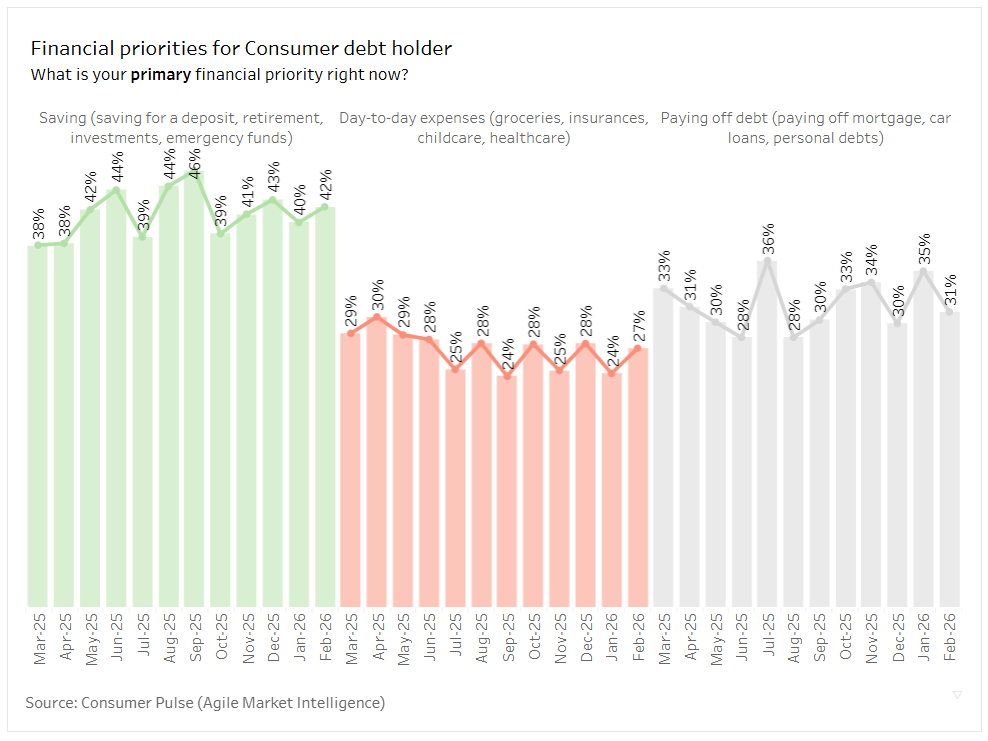
42% of consumer debt holders prioritise savings
- The majority of consumer debt holders view savings as their financial priority (42%).
- 31% of the population is worried about their debts, a 4 percentage point decrease from last month.
- 27% of the population is concerned about day-to-day expenses, a growing trend since January 2026.
Savings continues to be the financial priority for the majority of consumer debt holders (42%), a 2% increase from last month. Day-to-day expenses remain to be a priority for more than 1 in 4 of the population (27%). As more are concerned about their savings and day-to-day expenses, fewer are worried about their debts (31%), seeing a 4% decrease from January. The cost of living has incrementally increased in December 2025 compared to the previous quarters, although there had been offsets in the areas of health and power in households in that quarter, allowing room to move funds elsewhere, namely savings.
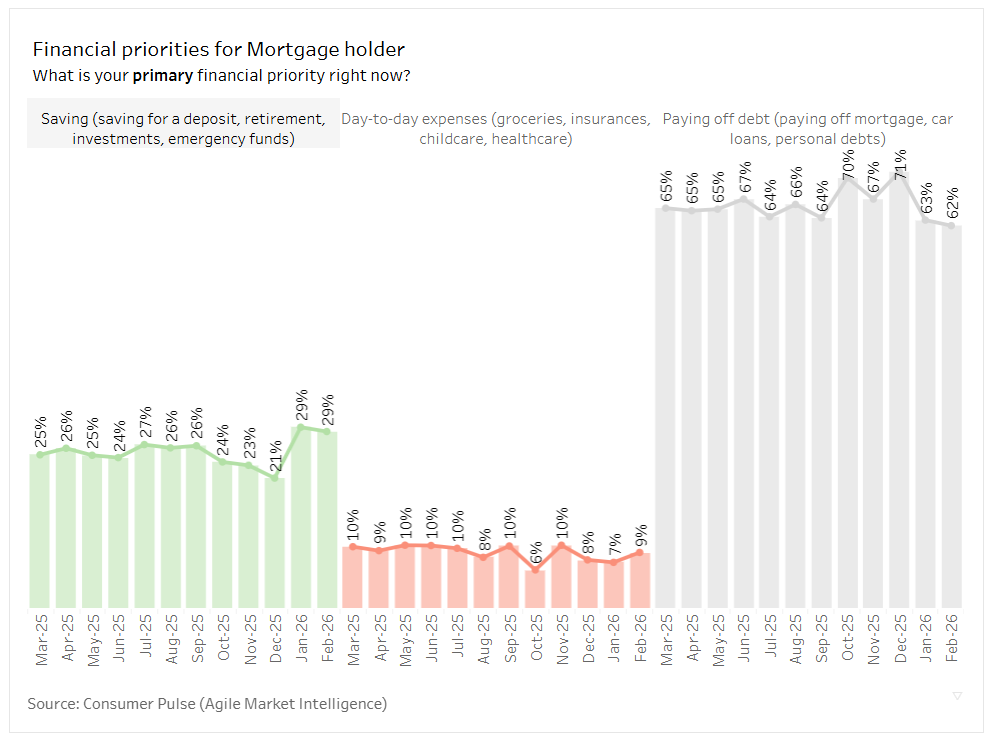
29% of mortgage holders are prioritising savings over paying debts
- Paying off debts is still the primary financial priority of mortgage holders (62%).
- Nearly 1 in 3 individuals from this segment are turning towards savings as their financial priority.
- Day-to-day expenses remain to be the lowest priority for this segment (9%).
The last quarter of 2025 gave mortgage holders some respite, resulting in a 9 percentage point decrease in the population of those prioritising debts as their financial priority (from 71% in December 2025 to 62% in February 2026). This segment, instead, has opted to set aside their funds for savings, an upward trend since 2025. From being a priority for 21% of the population last December, savings is currently a priority for 29% this February. Major banks have just announced that they will be passing on the interest rate hike to loan customers, and this relief for mortgage holders may be short-lived as borrowing costs rise again in the coming months.
“Mortgage holders have been prioritising savings for the last month due to the interest decrease last December, and continue to prioritise this despite the increase in interest by 0.25% this February,” said Michael Johnson. “It remains to be seen if this will be a consistent trend as the predicted price hikes and inflation rates occur in the months to come.”
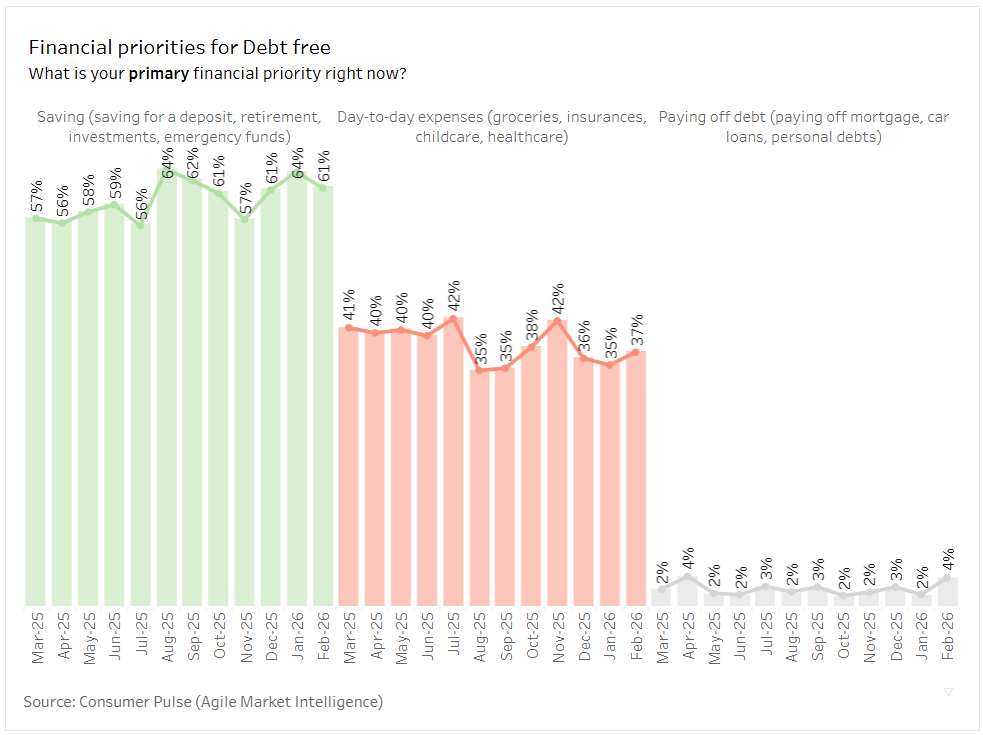
Savings remains a priority for 3 in 5 debt free Australians
- Debt free Australians continue to prioritise savings across the various financial obligations (61%).
- More debt free Australians are prioritising their day-to-day expenses (38%) and debts (1%).
Sixty one percent of debt free Australians (those without a mortgage or consumer debt) still view savings as their main financial concern; the top priority for this segment. This sentiment has decreased, however, by 3 percentage points from January 2026. By contrast, more individuals are concerned about their day-to-day expenses and other forms of debt this month. From 35% last month, at present, about 37% of debt free Australians are worried about their daily needs. A similar increase is visible for debts, from a population of 2% up to 4% are concerned about their debts. This small increase may be due to the Reserve Bank of Australia’s increased cash rate, as consumers who plan to acquire mortgages will likely be subject to higher interest rates.
About the research
This article is based on findings from Agile Market Intelligence’s Consumer Pulse survey, conducted from March 2025 to February 2026. Results were weighted to reflect national population profiles by age, gender, and state.
The Consumer Pulse is a monthly tracker developed by Agile Market Intelligence to monitor consumer sentiment, financial stress, and behavioural shifts across key household segments. The survey provides a real-time view of financial wellbeing in Australia, segmented by debt status, home ownership, and other demographics.
