


Australian consumers dramatically increased their engagement with digital platforms between August 2025 and February 2026, with social media, streaming services, and traditional TV as the leading media platforms. Research tracking 6,037 consumers over four months reveals that consumers are engaged with multiple platforms rather than solely sticking to just one or a few.
Key stats you need to know
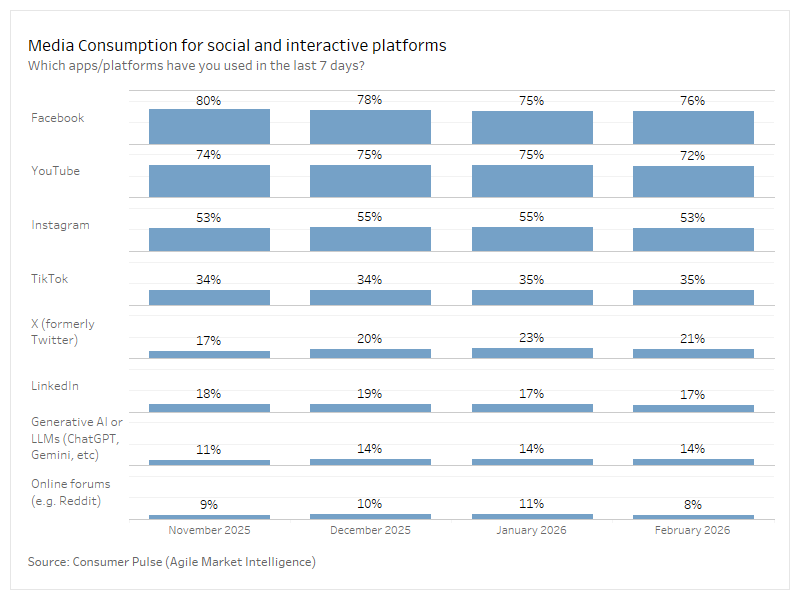
- Facebook shows the highest engagement at 76% among the social media platforms in February 2026.
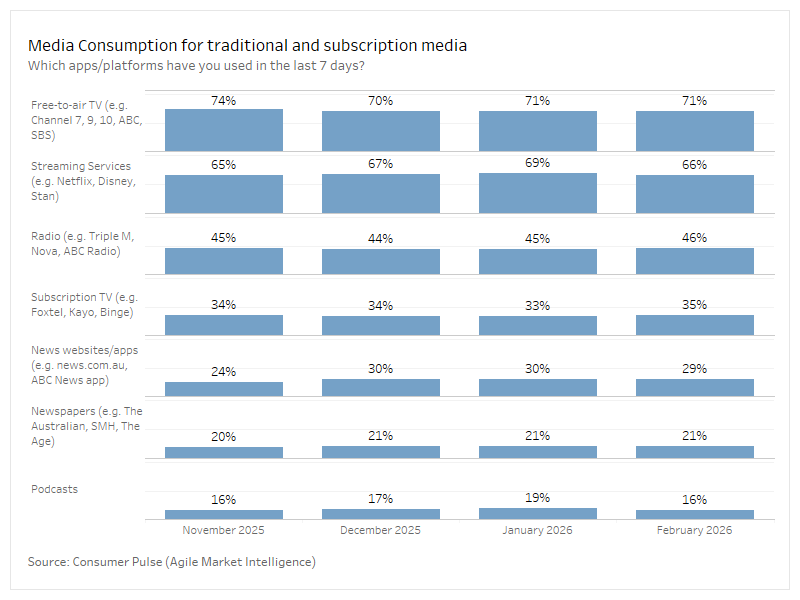
- 71% of consumers engaged with television, the top platform among traditional media.
- Streaming services (Netflix, Disney, Stan) are the leading subscription media in February, landing at 66% engagement.
Social media platforms now reach over two-thirds of consumers
- Facebook engagement reached 76% of consumers by February 2026.
- YouTube follows second with an engagement of 72%, whilst Instagram landed third, reaching 53% of consumers.
- TikTok maintained a steady engagement between 34-35% in the last four months.
The convergence of social platforms at the 35-76% engagement level indicates consumers are adopting multi-platform behaviour rather than switching between channels. With the leading social and interactive platforms being Facebook, YouTube, Instagram, and TikTok, these are also the primary channels in which businesses may find and interact with their target audience.
"The simultaneous growth across Facebook, YouTube and Instagram signals a fundamental change in how consumers allocate their attention," says Michael Johnson, Director at Agile Market Intelligence. "Professional services firms can no longer treat social media as a secondary channel. When two-thirds of your audience is active on these platforms weekly, they've become primary touchpoints for brand engagement and thought leadership."
Traditional television remains stable despite digital surge
- Free-to-air TV maintained engagement between 71-74% throughout the four-month period.
- Streaming services engaged 66% of consumers in February 2026.
- Radio maintained engagement with nearly half of consumers, ranging between 44% and 46% in the four-month period.
- News websites increased by 5 percentage points from 24% to 29%, showing a marginally significant upward trend.
Traditional television's resilience challenges assumptions about cord-cutting and streaming replacement. Rather than substitution, the data shows addition. Consumers maintained TV viewing whilst adding streaming and social platforms to their media diet.
"Traditional TV isn't dying, it's being supplemented," says Michael Johnson. "The real story is the expansion of media consumption overall. Consumers are spending more time across more channels. For B2B marketers, this means integrated campaigns are no longer optional. Your audience isn't choosing between channels, they're using all of them."
Emerging tech shows gradual adoption in the four-month period
The use of generative AI tools such as ChatGPT or Gemini reached 14% of consumers in February 2026, and this tech’s emergence as a media channel is particularly noteworthy. Whilst not a leading media engagement platform, over 1 in 10 consumers utilising this technology indicates early mainstream crossover.
"Generative AI appearing as a media channel at all is the story," says Michael Johnson, Director at Agile Market Intelligence. "We're watching real-time adoption of a technology that didn't exist as a consumer product two years ago. For professional services, this creates both opportunity and risk. Your clients are already using these tools to synthesise information. As such the question isn't whether to engage with AI-driven discovery, it's whether you're ready for it."
About the research
This analysis draws on data from Consumer Pulse, an ongoing tracking study of Australian consumer behaviour and media engagement. The research encompasses 6,037 completed responses collected between November 2025 and February 2026. Respondents were asked to identify which media channels, platforms or apps they had engaged with in the past week from a list of 17 options. The study tracks consumer-level behaviour and is not weighted by demographic factors.
