


Saving becomes the top financial priority
Australian households are shifting their focus toward building financial buffers:
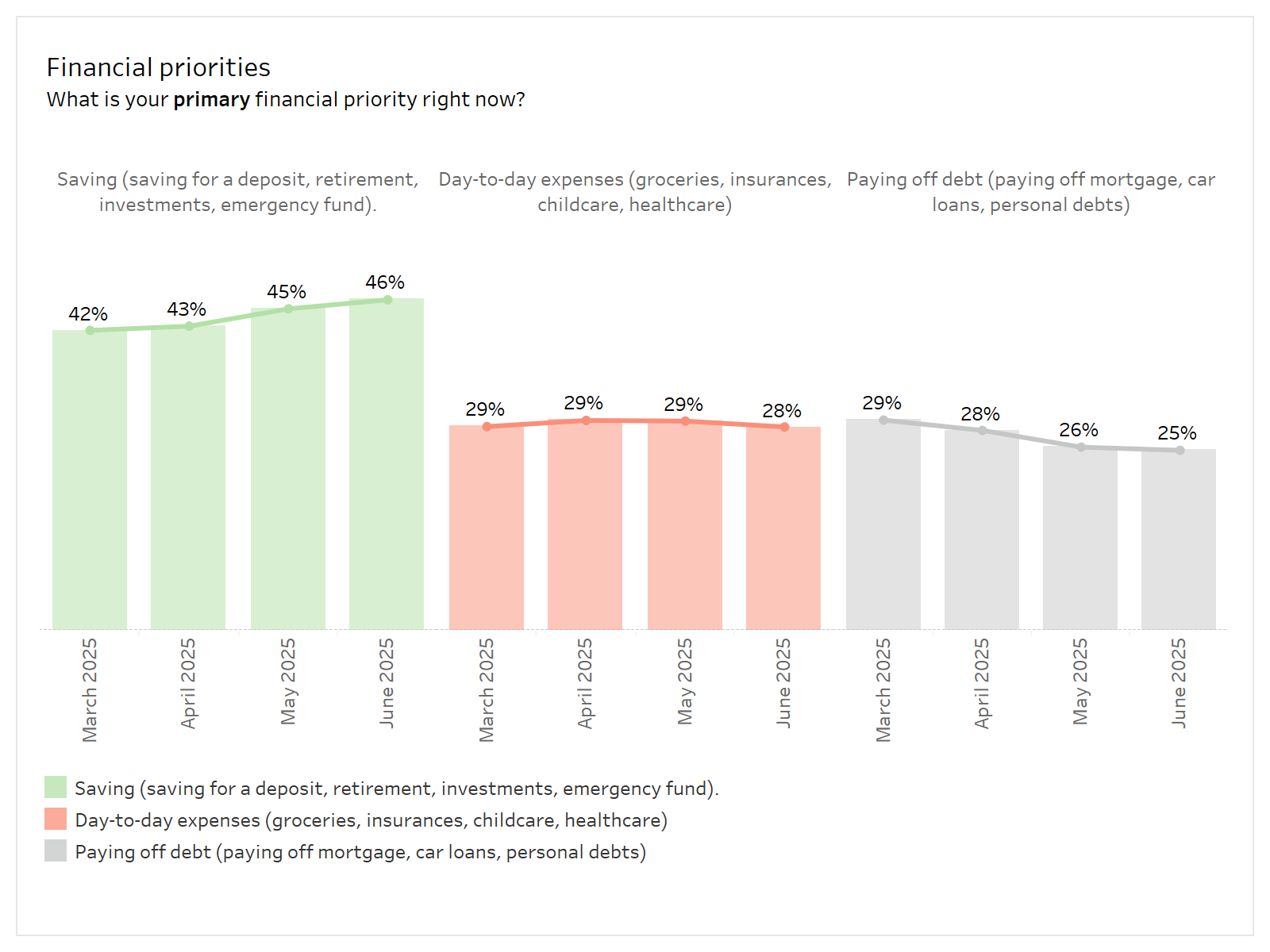
- In June, 46% of consumers said saving was their primary financial priority-the highest proportion recorded in 2025.
- The share prioritising debt repayment fell to 25%, down from 29% in March.
- Only 28% of households cited day-to-day expenses as their top concern, indicating a modest improvement in immediate cost-of-living pressures.
The steady rise in consumers prioritising saving signals a meaningful psychological shift among Australian households, from reacting to immediate cost-of-living stress to planning for long-term resilience. The increase to 46% in June reflects the highest level of savings intent seen this year, suggesting that more Australians are looking to re-establish emergency buffers or build toward medium-term goals like retirement, investments, or property deposits.
This pivot comes even as household budgets remain tight. Notably, the share of consumers prioritising day-to-day expenses has eased slightly to 28%, hinting that acute cost-of-living pressures may be plateauing. Similarly, the proportion focusing on paying off debt has declined from 29% in March to 25% in June, potentially indicating some success in deleveraging or a broader reprioritisation.
“We're seeing a mindset change. Australians are still doing it tough, but more are trying to take back control by setting money aside,” said Michael Johnson, Research Director at Agile Market Intelligence. “The fact that savings now top the list of financial priorities shows a collective desire to build security after a volatile period. It’s a fragile optimism, but an important one.”
This behavioural shift may also reflect broader economic signals, such as interest rate stability or improved employment confidence, giving consumers slightly more room to breathe and plan ahead.
About Consumer Pulse
The Consumer Pulse is a monthly tracker developed by Agile Market Intelligence to monitor consumer sentiment, financial stress, and behavioural shifts across key household segments. The survey provides a real-time view of financial wellbeing in Australia, segmented by debt status and home ownership.
