


Agile Market Intelligence’s Consumer Pulse survey asks Australians about their investing habits. Results show that couples, regardless of whether they have children or not, are most likely (45-51% of couples) to own their primary home. For all other household types, renting is the most common living situation. Meanwhile, the study also revealed that having dependent children, whether as a couple or a solo parent, drives the intent to invest in their primary home in the next 12 months.
Key stats you need to know
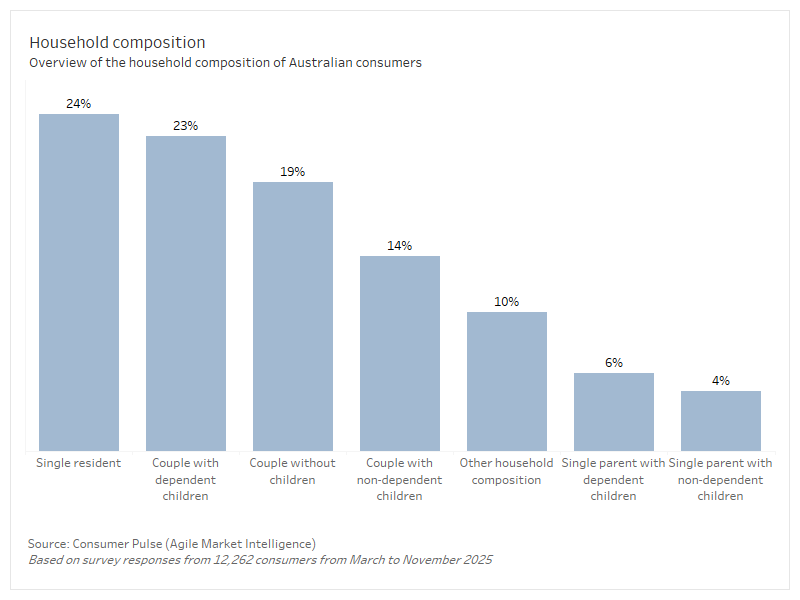
- About a quarter (24%) of Australian adults are living solo, making it the most common household composition, just ahead of couples with dependent children (23%).
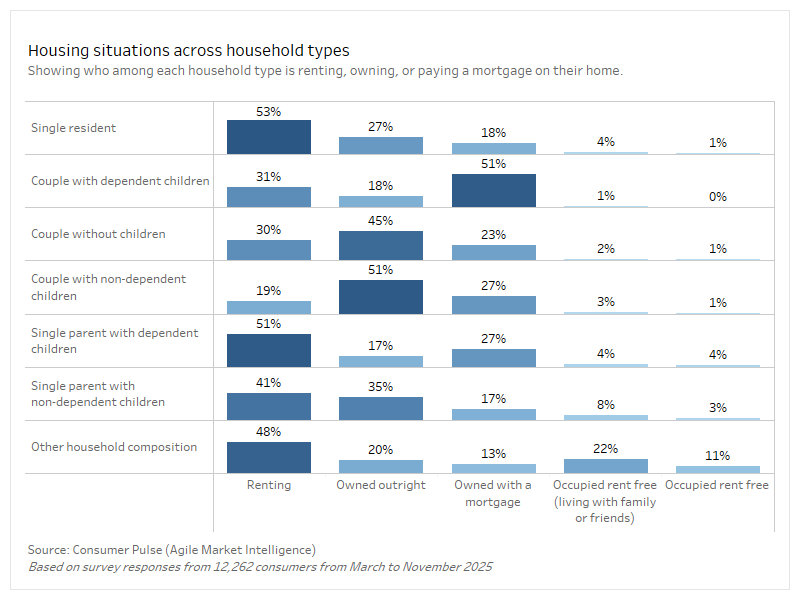
- 68-78% of couples surveyed own their primary home (outright or with a mortgage), ahead of single parents (42-44%) and single residents (45%).
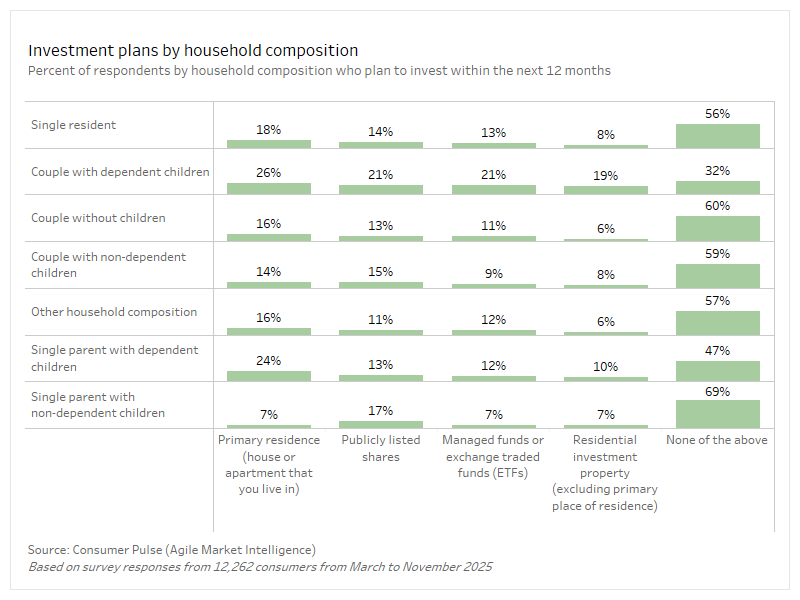
- For investment intent, 26% of couples with dependent children and 24% of single parents with dependent children are planning to take out a mortgage for their primary home within the next 12 months.
- Couples with children are also the biggest group planning to invest overall (stocks, ETFs and investment properties).
Australian households: Single living and family formation shape the landscape
- Single residents represent 24% of Australian adults, the largest household composition category.
- Couples with dependent children account for 23% of households, nearly matching single-resident households.
- Couples without children comprise 19% of households, while single parents with dependent children make up 6%.
Single living is now the most common arrangement at 24%, nearly matching couples with dependent children at 23%. Couples without children comprise the third largest group at 19%. Single parents with dependent children make up 6% and with non-dependent children 4%. Other household compositions, such as having housemates or living with relatives, make up 10% of households.
"Household diversity is the new normal. Single living and family formation are now nearly equal forces shaping Australia’s consumer base.” said Michael Johnson, Director of Agile Market Intelligence.
Couples dominate primary residence ownership
- The majority of couples with no children (45%), or with non-dependent children (51%) own their homes outright.
- 51% of couples with dependent children own their homes with a mortgage.
- 53% of single residents are renting, along with 51% single parents with dependent children, and 41% of single parents with non-dependent children.
Couples hold the strongest foothold in primary residence ownership. Without dependent children, 45-51% of couples own their homes outright. Couples with children are most likely to own their home with a mortgage. Couples can have a dual-income advantage and/or a greater borrowing capacity, which can accelerate home ownership.
"The dual-income structure gives couples the capacity to commit to mortgages at higher rates than other household types. Renting remains to be what the majority of single residents, solo parents and other household compositions turn to." said Michael Johnson.
Dependent children drive investment intent across all household types
- 26% of couples with dependent children plan to take out a primary residence mortgage within the next 12 months. They also have the highest intent for other types of investments.
- 24% of single parents with dependent children intend to invest in a primary home mortgage, narrowly matching coupled families.
- For the child-free, couples show lower intent at 21% and singles trail at 18%.
Having dependent children emerges as a powerful predictor of investment intent in primary residences. The 2-percentage-point gap between couples and single parents with dependents reveals that parenthood, not household structure, shapes financial priorities. This pattern intensifies when examining single parents without dependents, who show starkly different behaviour. Only 7% intend to purchase a home, and 69% have no investment plans at all. In contrast, couples with dependents lead across all investment categories from stocks and managed funds to investment properties.
“Dependent children act as a catalyst for housing investment across all household types. The 24% intent among single parents versus the 7% among solo parents without dependents tell you that family stage (and not structure) changes financial behaviour.” Michael Johnson said.
About the research
This article is based on findings from Agile Market Intelligence’s Consumer Pulse survey, conducted across March to November 2025. The data presented are for 12,262 consumers who were asked about their household compositions, current investments and investment intentions. Results are weighted to reflect national population profiles by age, gender, and state.
The Consumer Pulse is a monthly tracker of over 1,500 Australian consumers developed by Agile Market Intelligence to monitor consumer sentiment, financial stress, and behavioural shifts across key household segments. The survey provides a real-time view of financial wellbeing in Australia, including debts, investments and financial priorities.
