


Consumer Pulse is an always-on survey of Australian consumers that collects information on their attitudes, experiences and priorities towards their finances and financial institutions. The survey tracks consumer sentiment based on their financial security/anxiety, their perceived financial health relative to a year ago, and their reported household cash flow for the current month. Last November 2025, consumer prices dropped from 3.8 to 3.4%, prices didn’t increase as high as initially perceived. This lightens the purchase for consumer goods, as well as slightly easing the burden for homeowners. Despite this, there is a potential for price hikes later in 2026, drawing caution from Australians regarding the state of their finances as the year begins.
Key stats you need to know
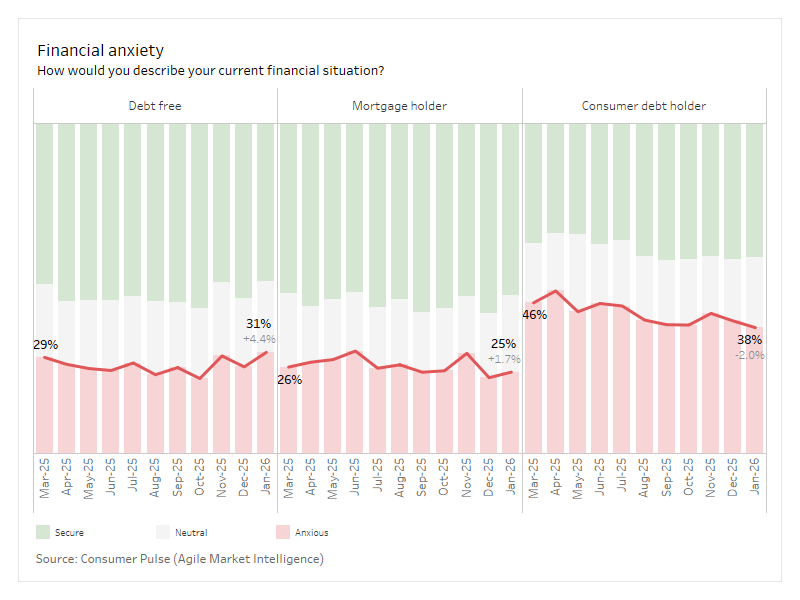
- The number of financially anxious consumer debt holders has remained relatively the same in the past several months, and continues to be the most anxious group across the various debt statuses.
- More debt free consumers (31%) are anxious about their financial situation this January 2026.
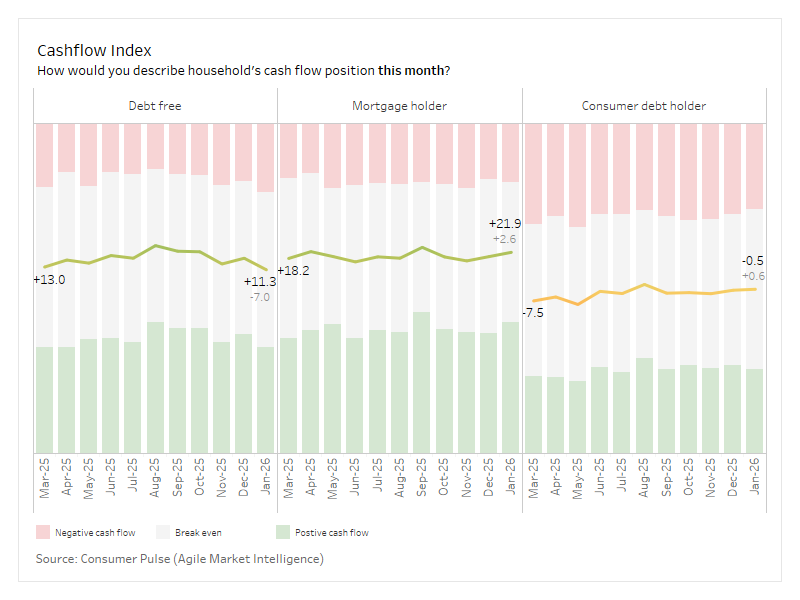
- Only consumer debt holders report negative cash flows for the time being (-0.5).
Nearly 4 in 10 consumer debt holders feel financially anxious at the start of the year
- Consumer debt holders are the most anxious about their financial status in January 2026, despite seeing a drop of 2 percentage points.
- More debt free households and mortgage holders grew financially anxious compared to the previous month.
- 1 in 4 mortgage holders are financially anxious in January 2026, the least financially anxious out of all the segments.
Based on debt status, the segment feeling the most anxiety at the start of the year is consumer debt holders (38%), followed by debt-free households (31%), and mortgage holders (25%). Interestingly, the debt free households saw the largest increase in financial anxiety from last month, growing by +4.4%. Meanwhile, consumer debt holders feeling financial anxiety dropped -2.0% amidst the unexpected inflation drop. The contrast spells very different reactions to the economic backdrop at the start of the year.
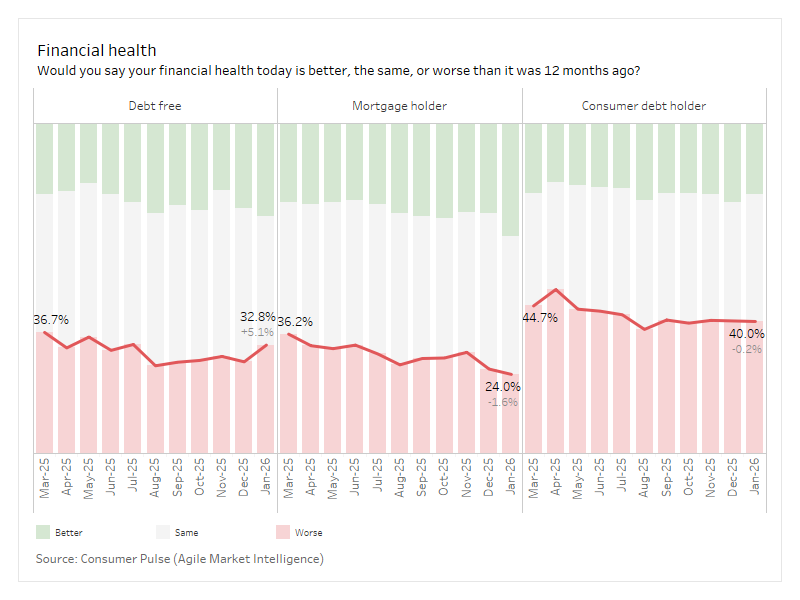
Almost 3 in 4 mortgage holders believe that their financial health has improved or remained the same since last year
- The share of mortgage holders concerned about their financial situation (24%) has decreased, following a downward trend since November 2025.
- This month, 2 in 5 consumer debt holders believe that their financial health has worsened in the past year.
- 5.1% more debt free Australians say their financial situation has worsened compared to one year ago.
Debt free Australians feel that their financial health has worsened compared to 12 months ago, a sentiment expressed by 32.8% of this group. The case is opposite for mortgage holders, with 1.6% more reporting that their finances have improved or remained as is, reflecting differing views amidst the same economic backdrop. The largest group of financially anxious Australians are consumer debt holders, with 40% of them expressing concern over their situation. The sentiments of this group have not changed drastically in the past few months, implying that consumers are neither growing more nor less concerned despite the changes in market values and legislation.
Debt free Australians and mortgage holders show positive cash flows in January 2026
- Mortgage holders have the most positive cash flow at +21.9.
- Debt free Australians have the second-highest cash flow at +12.4.
- With a score of -0.5, consumer debt holders are the only group with negative cash flow.
Following a steadily increasing trend, mortgage holders report the highest score of positive cash flows this month, an increase of 2.6 points. Despite an increase of 0.6 points, consumer debt holders still report negative cash flows on average. Unsurprisingly, despite a drop of 7 points, debt free Australians still showcase positive cash flows for January 2026.
About the research
This article is based on findings from Agile Market Intelligence’s Consumer Pulse survey, conducted from 1 March 2025 to 11 January 2026. The survey collected responses from 15,672 Australian consumers, weighted to reflect national population profiles by age, gender, and state. The survey gathers about 1,500 responses monthly. As of the time of writing, 635 responses were gathered for January 2026.
The Consumer Pulse is a monthly tracker developed by Agile Market Intelligence to monitor consumer sentiment, financial stress, and behavioural shifts across key household segments. The survey provides a real-time view of financial wellbeing in Australia, segmented by debt status, home ownership, and other demographics.
