


Following an unexpected drop in the inflation rate, the cost of goods and services has become slightly more affordable in the meantime, allowing Australians to shift their focus to other financial priorities, such as savings, at the start of the year.
Capturing data from roughly 1,500 monthly respondents, Agile Market Intelligence’s Consumer Pulse survey monitors shifting financial priorities of Australian consumers, subdivided into those with consumer loans, those with home loans, and those who are debt free.
Key stats you need to know
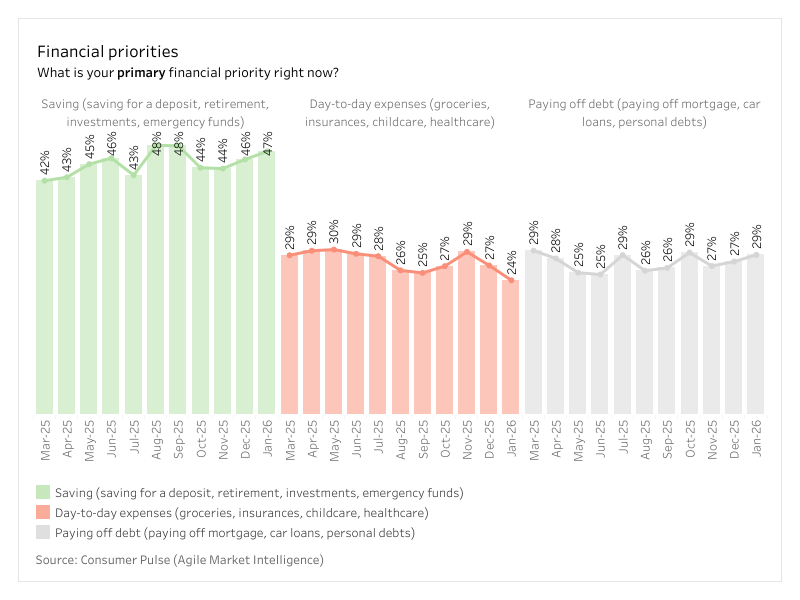
- Overall, 24% of Australian households are prioritising day-to-day expenses in January 2026, the lowest proportion recorded since tracking began.
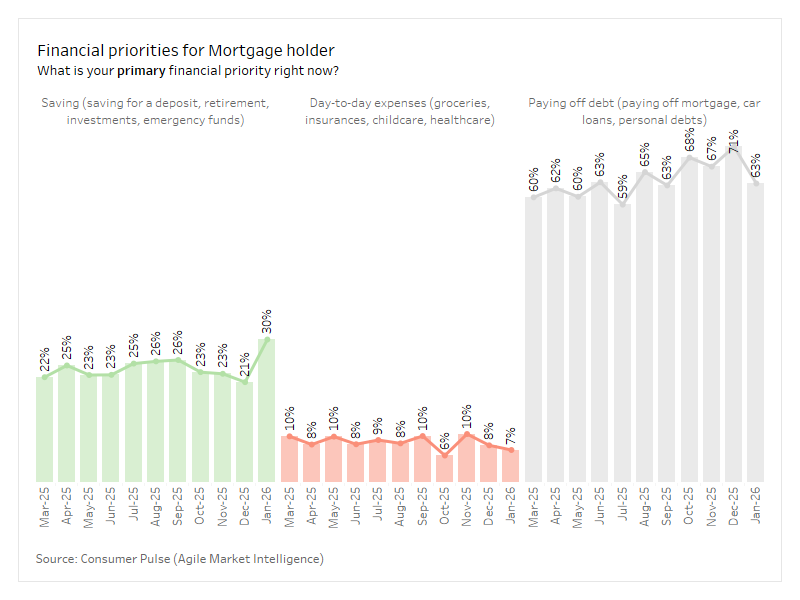
- Mortgage holders are experiencing the biggest ease this month, as the share of households prioritising savings grew by +9 percentage points (from 21% in December to 30% this month).
- Paying off debts remains the top priority for 63% of mortgage holders and 41% of consumer debt holders.
47% of Australians cite savings as their primary financial concern
- The top financial priority among Australians is setting aside funds for savings.
- 29% of Australians are prioritising paying off their debts.
- Almost 1 in 4 of the population is focusing on day-to-day expenses, a 5 percentage point decrease from November 2025.
Saving remains the primary financial priority for Australians this month, gaining a slight increase (+1 percentage point) from December. Seconding this priority is the matter of paying off debts, which saw an increase of 2 percentage points from the previous month. There is a continuing downward prioritisation of day-to-day expenses. Presently, 24% of Australian households prioritise day-to-day expenses—the lowest proportion recorded since the start of tracking, and likely due to the recent decline in inflation.
“Australians are less concerned about their day-to-day expenses, thanks to the inflation drop at the start of the year,” says Michael Johnson, Director at Agile Market Intelligence. “This implies a decrease in costs for those with debts, and increased purchasing power for day-to-day expenses. However, consumers ought to be wary that an inflation drop now does not remove the possibility of an inflation hike later in the year.”
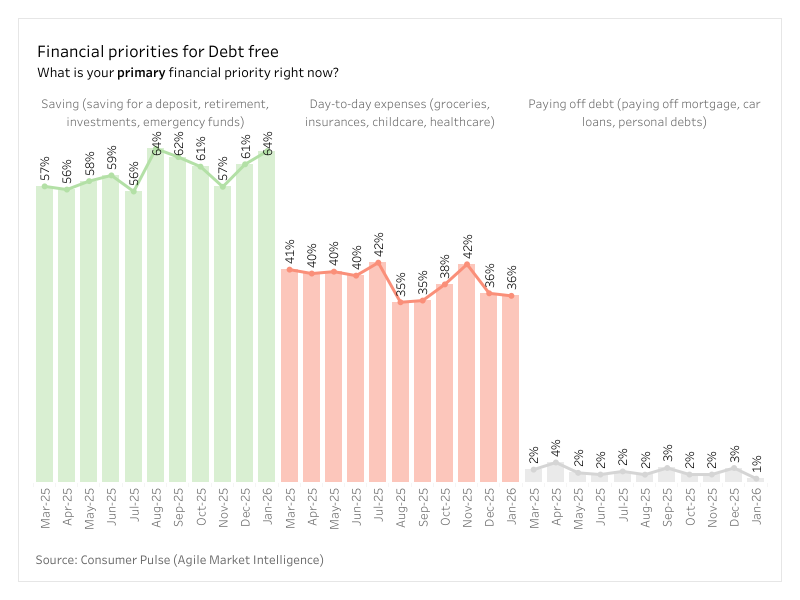
Debt free Australians are focusing on savings for January 2026
- 36% of debt-free Australians are concerned about their day-to-day expenses, a drop from 42% in November.
- 64% of debt-free households prioritise saving in January, representing the largest segment of the population doing so.
We define debt free households as those without mortgages or consumer debt. Sixty-four percent of debt free Australians are prioritising savings for this month, following a steadily increasing trend since November 2025. As the consumer price index went up in October 2025, 42% of households pivoted to prioritising day-to-day expenses. Now in the present, however, 36% of consumers are now concerned about it in January. As the worry for day-to-day expenses has decreased, this has granted room for Australians to grow their savings instead.
Mortgage holders saw the largest shift to saving at the start of the year
- While the primary financial priority for mortgage holders continues to be paying off debt (63%), the share of households has dropped considerably by 8 percentage points.
- 30% of mortgage holders, however, are focused on growing their savings, up 9 percentage points from December.
- Day-to-day expenses remain the lowest priority, concerning 7% of the population.
The main priority for mortgage holders remains to be the settlement of debts. However, fewer people are concerned about their loans and debts, having dropped by 8 percentage points in comparison to last month. By contrast, 9% more mortgage holders are focused on savings for January 2025, the second-highest priority for this group. As the annual inflation rate slowed to 3.4% (from 3.8%), mortgage holders are the segment feeling the most relief, as they shift their priorities to other matters, namely savings, to prepare for the potential price hike in the months to come.
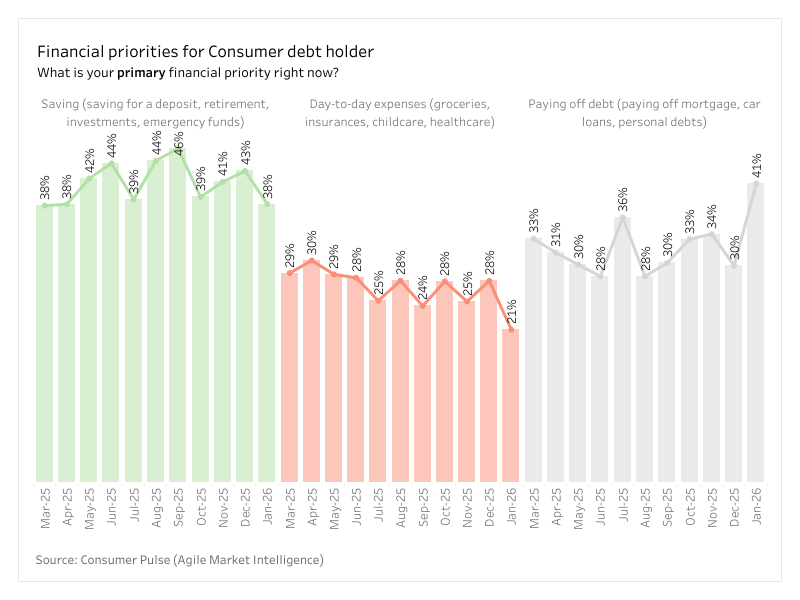
Settling debts is the priority for 41% of consumer debt holders
- 11% more consumer debt holders are prioritising settling debts.
- Savings remains the second highest priority for consumer debt holders (38%).
- Fewer are prioritising their day-to-day expenses, occupying 21% of this segment.
Following a different strategy from mortgage holders, consumer debt holders are prioritising the settlement of their debts this January, an 11% increase from December last year. This steep incline implies that consumers are maximising the current prices brought about by the slowed inflation rates before the potential price hikes occur. This shift has steered consumers away from their day-to-day expenses (less 7%) and funds for savings (less 5%), compared to the previous month.
About the research
This article is based on findings from Agile Market Intelligence’s Consumer Pulse survey, conducted from 1 March 2025 to 11 January 2026. Results were weighted to reflect national population profiles by age, gender, and state. Responses were collected from 15,672 Australian consumers, 635 of which were gathered this January.
The Consumer Pulse is a monthly tracker developed by Agile Market Intelligence to monitor consumer sentiment, financial stress, and behavioural shifts across key household segments. The survey gathers about 1,500 responses monthly, providing a real-time view of financial wellbeing in Australia, segmented by debt status, home ownership, and other demographics.
