


LEAP Legal Software’s Profitability in Law: Global Report 2026 draws on insights from 700 legal practitioners to examine trends in knowledge retention and staff training in legal practices across three key markets.
The report finds that, globally, over half of firms lack adequate knowledge retention documentation, a challenge particularly pronounced among those in AU/NZ.
Key stats you need to know
- 6 in 10 say the level of staff training and expertise in their firms are good or excellent.
- More than half (53%) of firms have a limited or no documentation process for knowledge retention when employees leave.
- AU/NZ firms lag behind in knowledge documentation and employee training compared to their counterparts in the UK/IE and the US/CA.
60% of firms report having good or excellent staff training and expertise
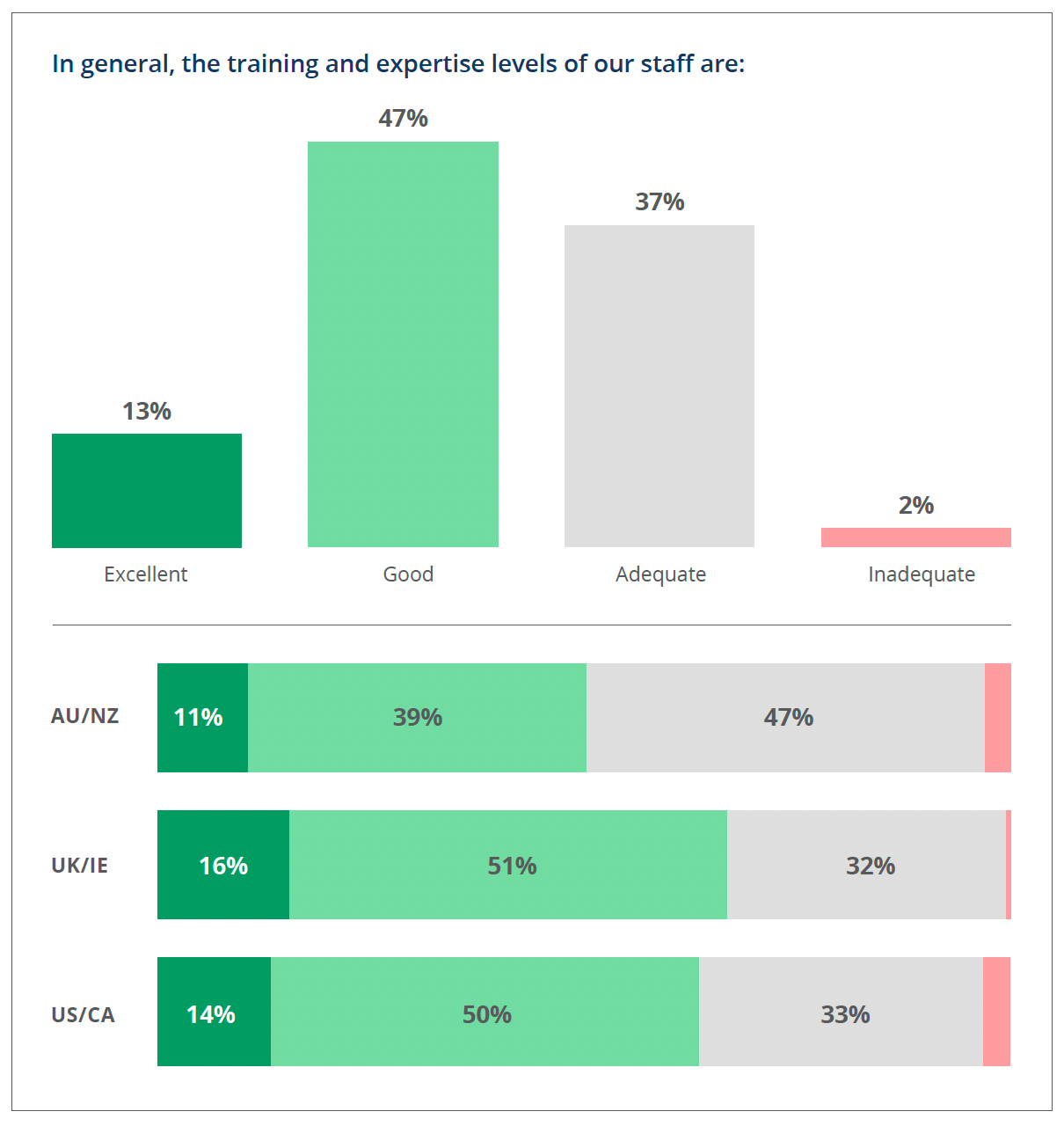
- 47% of firms describe their staff training as good, with a further 13% describing it as excellent.
- More firms (67%) in the UK/IE describe their staff training and expertise as either excellent or good compared to the global average (60%).
- 1 in 2 (50%) firms in AU/NZ rate their training programs and support as good or excellent, lagging 10 percentage points behind the global average.
More than 1 in 10 (13%) firms rate their staff training and expertise as excellent, while nearly half (47%) describe it as good. However, a substantial share (37%) still considers their training to be only adequate.
UK/IE firms lead on staff training, with 2 in 3 (67%) rating it as good or excellent. US/CA follows at 64%, while AU/NZ trails at 50%. As a paralegal in a UK firm puts it, “We are constantly learning and undertaking [continuous professional development] CPD hours to remain up to date with the current law."
“With only 50% of AU/NZ firms reporting good or excellent training, there’s a real risk AU/NZ firms will develop skills gaps compared to global peers,” said Michael Johnson, Director at Agile Market Intelligence.
AU/NZ firms lag behind US/CA and UK/IE firms in knowledge retention
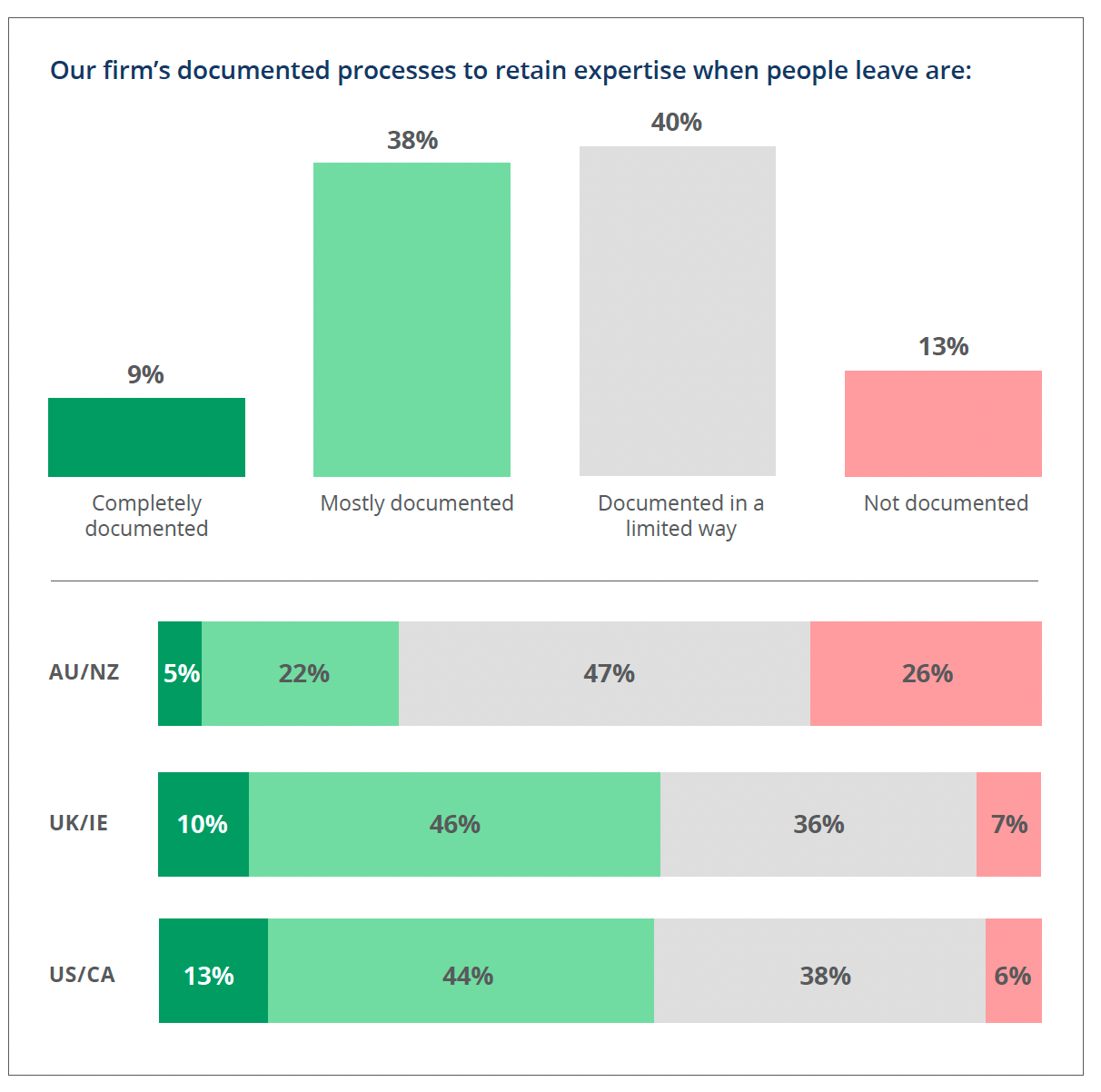
- Globally, 47% of firms report having documentation processes that at least mostly retain expertise when employees leave.
- US/CA firms lead in knowledge retention, with 44% saying they mostly document expertise, and a further 13% saying they perform a comprehensive documentation process.
- More than 1 in 4 AU/NZ firms lack any formal documentation for knowledge retention.
Nearly half of firms (47%) report having documentation processes that at least ‘mostly’ retain knowledge when employees leave, including 9% that say their processes capture all knowledge. Meanwhile, 40% have limited documentation and 13% have none at all, highlighting an almost even split in knowledge retention maturity across global firms.
Zooming into regional nuances, AU/NZ emerges as a key drag on the global knowledge retention average, with 26% of firms reporting no formal documentation process when employees leave, double the global average. Furthermore, only 27% of AU/NZ firms have processes that at least ‘mostly’ retain expertise, well below 56% in the UK/IE and 57% in the US/CA. As an AU-based lawyer noted, “Many people handle something themselves from beginning to end or are the only author who can handle that one type of matter, so when they leave, things often fall apart.”
“The data clearly shows that AU/NZ firms are falling behind their global counterparts in capturing critical knowledge,” noted Michael Johnson.
“Without robust documentation processes, expertise walks out the door every time an employee leaves, creating gaps that can take months to fill.”
About the research
LEAP Legal Software’s Profitability in Law: Global Report 2026 is based on quantitative research conducted by Agile Market Intelligence, reflecting the sentiments of 700 legal professionals across Australia, New Zealand, the United Kingdom, Ireland, the United States, and Canada, and collected between 10 and 28 November 2025. The report outlines how strategy, people, technology and AI drive profitability in legal practice, with data-driven recommendations on how to close the gap between profitability potential and execution.
You can download the report here.
