

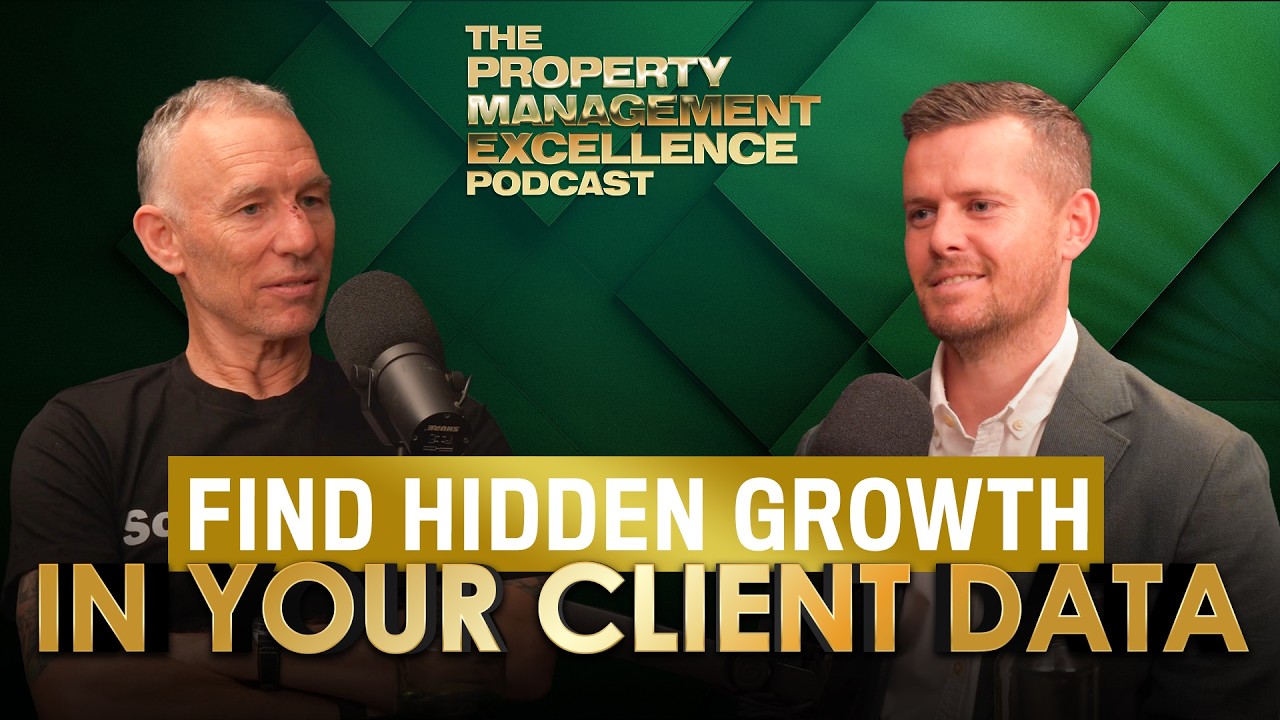
This article is adapted from an episode of The Property Management Excellence (PMX) Podcast, where host Alex Whitlock speaks with Michael Johnson, Director at Agile Market Intelligence. They discussed how property management agencies can build businesses grounded in evidence. In the conversation, Michael outlines a four-part approach to making better business decisions, applicable well beyond property management.
Why evidence is important for businesses
Most business owners know they should be "more data-driven." Fewer know what that actually means in practice, nor do they know why so many attempts to use data end in dashboards nobody looks at and insights nobody acts on.
The difference is not data; it is evidence.
Evidence is data with a purpose: information gathered to answer a specific question, test a specific hypothesis, or support a specific decision. An evidence-based business does not collect everything and hope for insight. It starts with the decision, works backwards to what proof is needed, and builds a repeatable system around that.
Evidence-based vs data-driven
The term "data-driven" often triggers the wrong instincts. It sounds like work: dashboards, analysts, and complex tooling. Some businesses respond by collecting everything, building reports, and waiting for someone to "find the insight that makes us millions." That is not how data works. A better framing is looking at data through an evidence-based lens.
Data exists to provide evidence for business decisions. Before gathering anything, ask:
- What decision am I trying to make?
- What would I need to see to make it confidently?
- How will I know if a change I made actually worked?
Without those questions, data becomes noise. With them, even a small agency with limited resources can build a disciplined approach to growth.
The framework: Objectives → Results → Drivers → Initiatives
Think of the four-part framework for becoming an evidence-based business as a tree. At the top sits the objective; the outcome the business wants to reach. Below it, the measurable result that confirms the business has achieved it. Branching from that are the drivers: lead indicators that predict whether the business is on track. At the base are the initiatives: the specific actions the business ought to take to move those drivers.
This structure is closely related to OKRs (Objectives and Key Results), but the emphasis here is on the middle layer, the drivers, which is where most businesses skip straight from "we have a problem" to "let's try something."
Step 1: Objectives: Decide what matters
Start by writing down the business’ three key business objectives. Not more than that, just three.
For a property management agency, for instance, a foundational objective might be: Retain the owners already on our rent roll. This is not a secondary concern. Owner retention is the cheapest form of marketing and the platform every growth strategy depends on. Property management agencies will lose owners when they sell; that is natural churn. What the business cannot afford is losing them to a competitor because of service failures that could have been seen coming.
Other objectives might include growing the rent roll by a set number of properties, improving team productivity, or increasing average management fees. But retention belongs at the top of the list for most agencies, because a business cannot grow what it cannot hold.
Step 2: Results: Define what success looks like
An objective without a measure is a wish. Turn each objective into a key result; a number that tells whether the business has hit its goal.
For retention, that might be: 95 per cent year-on-year owner retention.
How the business sets the number matters less than having one. Look at the historical performance and benchmark against other agencies in the area or nationally, if data is available. Set a numerical target that is ambitious but grounded. One-hundred per cent is unrealistic, but "we want to keep most of our owners" is not actionable. The key result becomes the business’ north star. Everything below it exists to explain and influence that number.
Step 3: Drivers: find the lead indicators
This is the step most businesses miss. For example, knowing that the business lost 27.6 per cent of its rent roll last year is a result. Understanding what that number is made of, and what signals churn before it happens, is the purpose of identifying drivers. Drivers are lead indicators; measurable factors that predict future outcomes.
The tricky part is that not everything is a driver. It is imperative to isolate what actually predicts an owner leaving. This is not what feels important, but what the evidence shows correlates with churn.
Here are the ways to gather driver evidence:
- Quantitative measures: response times, contact frequency, inspection completion rates, maintenance turnaround. Most of this already exists in the business’ property management software.
- Qualitative feedback: owner surveys (for larger agencies) or structured phone calls to a sample of owners each month (for smaller agencies). You do not need to call everyone; 10 per cent of your owner base, rotated regularly, builds a reliable picture.
The goal is not perfection. The goal is to move from guessing why owners leave to having a working theory that can be tested.
Step 4: Initiatives: take action and measure the effect
Once the drivers are known and how to measure them, now comes the implementation of initiatives. These are specific changes designed to move those drivers in the right direction.
For example:
- Introduce a KPI: every email answered within one business day
- Schedule quarterly owner check-in calls, separate from maintenance or rental review conversations
- Run an annual NPS (Net Promoter Score) survey to benchmark advocacy
- Brief the team on a shared retention objective, backed by the evidence you have gathered
Then comes the final but critical step: review whether the initiative moved the driver, and whether the driver moved the result.
Did faster email response times correlate with fewer owner departures? Did quarterly calls improve satisfaction scores? If yes, keep going. If not, stop investing time in something that is not working, and try a different initiative.
This turns business improvement from wild guessing into structured experimentation:
- Objective → Retain owners
- Result → 95% retention
- Driver → Email response time
- Initiative → 24-hour response KPI
- Review → Did response time improve? Did retention improve?
Running the framework: a quarterly rhythm
This is not a daily exercise; it is a quarterly discipline. As such, it is essential to continuously practice the following:
- Review key results: Is the business on track against its main KPIs?
- Review drivers: Are the lead indicators moving in the right direction?
- Assess initiatives: Did the new change implement what it should? Did it work?
- Adjust: Double down on what is working, discontinue what is not, and design new initiatives for drivers that are not moving
Over time, this becomes a habit. Agencies that embed this rhythm, alongside systems and operational structure, are the ones that grow consistently. Those that stay trapped in reactive "doing" without ever stepping back to review tend to stagnate or shrink.
Why evidence changes how your team responds
This framework is not just a management tool. It is a change management tool.
Compare these two conversations with a property manager:
Without evidence: "I need you to call your owners once a quarter. Thanks, goodbye."
With evidence: "Our analysis shows owner attrition is linked to low engagement between transactional contact. Retaining our rent roll is our top objective this quarter. We need you to call your owners once a quarter. Here are the reasons why, and here is how we will measure whether it is working."
The second conversation gives the team a shared story. The initiative is not an arbitrary rule. It is an experiment connected to a measurable outcome. If the evidence shows it is not working, then stop. That removes resistance and builds buy-in in a way that top-down mandates never do.
Applying the framework to growth
The same structure works for growth, not just retention. The objective changes; the logic does not.
Objective: Grow the rent roll by 50 properties this year.
Result: 50 net new managements; then track the source of each new owner.
Drivers:
- Net Promoter Score (are existing owners likely to refer you?)
- Referral rate (what percentage of new owners came from existing clients?)
- Channel effectiveness (which marketing channels produce owners who stay?)
Initiatives:
- NPS survey to identify promoters and detractors
- Referral conversation built into owner check-in calls
- "How did you hear about us?" question at every onboarding
- Targeted presence in three channels where the ideal owners already exist
Before scaling marketing spend, use the framework to confirm alignment: Do the owners experience the service that should be delivered? Do the promoters outnumber detractors? Which channels actually work?
Marketing without that evidence amplifies misalignment. It ends up reaching more people with a message that does not match reality, which becomes a waste of time and money. Once alignment is confirmed, the business can scale with confidence.
Three principles for making evidence-based practices stick
1. Democratise access to evidence
Not everyone in the business needs to love data. But everyone should be able to see the evidence relevant to their role. Modern tools, including AI, make this easier than ever. The goal is not to create analysts; it is to give the team the proof they need to understand why change is happening.
2. Start small, review often
A research firm or a six-figure dashboard project is not needed. What is needed are three objectives, a handful of drivers, and a quarterly review. The agencies that grow fastest are often those that find the time to work on the business, not just in it.
3. Gather accurately, or decide wrongly
The framework only works if the evidence is reliable. Measure the right drivers. Ask owners directly, not just the property managers. Track why people leave, not just that they left. Bad evidence leads to bad decisions, and the framework cannot fix that.
Summary
Each section of the framework answers a specific question. The objective asks the overall goal: “what do we want to achieve?” The results reveal the path, or “how will we know we achieved it?” Drivers reveal the factors that predict success or failure. The initiative part asks, after analysing the context and answering the previous questions, what can the business do moving forward? Finally, the business ought to review whether the initiative worked, and check the drivers against the results.
An evidence-based business is not one that drowns in data. It is one that knows what questions to ask, gathers proof to answer them, acts on what it learns, and reviews whether the action worked.
That is the system. The rest is discipline.
Watch the full episode: PMX: Is your rent roll ready for its next growth phase?; a conversation between Alex Whitlock (PMX Podcast) and Michael Johnson (Agile Market Intelligence). The framework draws on research practices used with major financial institutions and real estate groups.
