


The accounting industry is now seeing near-term AI applications in day-to-day operations. Early adopters have tapped AI for marketing support and document processing, among other basic use cases. However, firms are still waiting to build more confidence in AI for high-stakes applications.
The Access Group’s State of AI in Accounting Report 2026 surveyed 434 accounting practitioners to plot their firms on the technology adoption curve and chart near-, medium-, and long-term AI integration trajectories.
By late 2026 onwards, many practices anticipate the successful implementation of AI in higher-stakes use cases.
Key stats you need to know
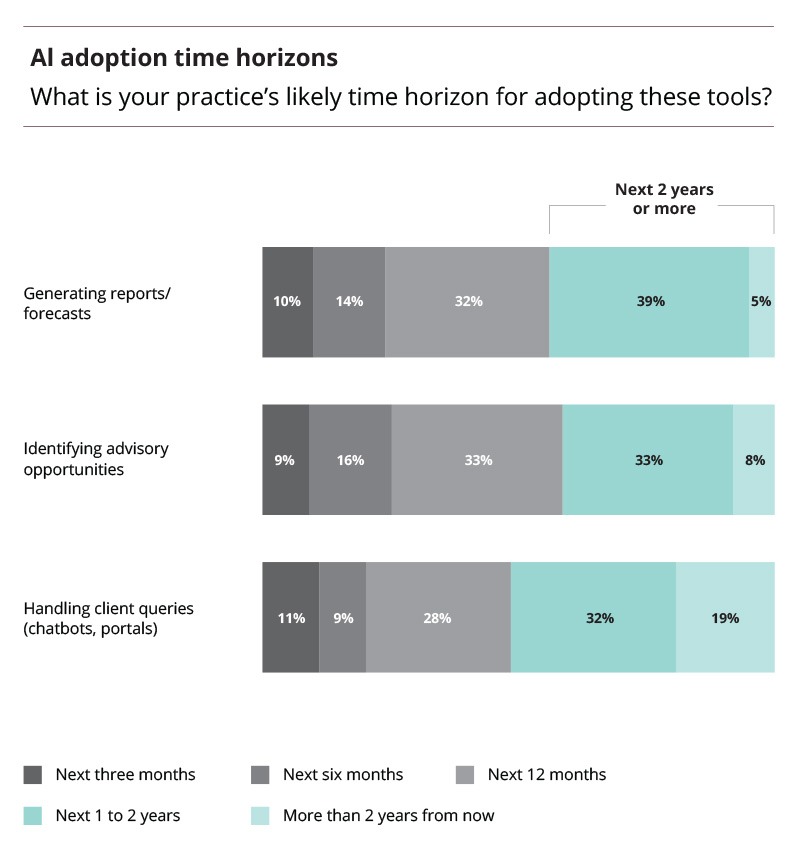
- Almost all accounting firms (95%) expect to use AI in generating reports/forecasts in 1-2 years or less; 56% believe they are one year to roll out.
- Another 1 in 3 anticipate AI support in identifying advisory opportunities in the next 1-2 years; an equal segment believes it will take 12 months.
- 1 in 5 believe AI still has a long way to go in handling client queries (2 years or more).
AI adoption in high-stakes applications imminent in the next 1-2 years
- AI-assisted report and forecast generation to be rolled out by 44% of firms in the medium- to long-term.
- A third (33%) of practices will use AI in identifying advisory opportunities.
- More than half (51%) of accounting firms say it would take at least a year to build confidence in AI handling client queries.
A 1- to 2-year window emerged as the most likely timeframe for firms to tap AI for generating reports and forecasts, with a segment share of 39%. Another 32% are optimistic that it could only take 1 year, while 24% say rollout could happen in 6 months or less. When it comes to identifying advisory opportunities, an equal share of firms (33%) anticipate timelines of 1 year and 1-2 years, respectively, for AI to be ripe for deployment.
Meanwhile, the majority of firms look at AI-driven handling of client queries as requiring longer incubation. Specifically, 32% stated it will likely materialise in the next 1-2 years, while another substantial segment (19%) says it could take longer than 2 years.
“By late 2026, the industry expects AI to take on more work that impacts critical outcomes — not just clerical tasks. Firms want automation that is accurate, auditable, and trustworthy, and that’s where investment is heading,” said Michael Johnson, Director at Agile Market Intelligence.
Mix of clerical and high-value workloads among the top 5 most impactful AI tools in 2-3 years
- 2 in 3 (67%) accounting firms see AI-driven automation of transaction coding/reconciliations to have the biggest impact in 2-3 years.
- More than 1 in 2 (57%) forecast that workflow/task automation will reshape accounting operations.
- Tax research/ATO monitoring (54%), document extraction & processing (52%), and report generation & forecasts (51%) follow suit.
Looking further out, AI tools expected to bring the most impact to accounting operations include transaction coding/reconciliations and workflow task automation, with 67% and 57% of firms registering optimism for the respective use cases to streamline accounting operations in the next 2 to 3 years.
Tax research/ATO monitoring closely trails behind at 3rd place, garnering a segment share of 54%. Document extraction and processing ranked 4th in terms of anticipated impact at 52%, while report generation & forecasts completes the top 5, after 51% of firms pointed to the use case as having the most potential to bring positive impact to the industry.
“Our findings point to the inevitability of going past AI being a nice-to-have. Rather, the majority of firms now see automating as mission-critical in the next 2 to 3 years,” said Michael Johnson.
“Firms are also expecting AI to tackle pain points such as tax research and document extraction, two use cases that hold high potential for time savings.”
About the research
The Access Group’s State of AI in Accounting Report 2026, conducted by Agile Market Intelligence, maps out AI adoption, risks and barriers holding back adoption, and the practical use cases already delivering value today. The report captures the sentiments of 434 accountants, bookkeepers and other accounting professionals across Australia around their experiences of artificial intelligence in their practice. Responses were collected between the 9th of September and the 13th of October 2025.
You can download the report here.
