

AI adoption is reshaping the accounting practice, yet firms remain cautious, with accuracy, data privacy, and training gaps perceived as bottlenecks. Standalone AI such as ChatGPT, Gemini, and Claude face greater scrutiny than embedded AI (AI features or software introduced in or by firms’ existing accounting software), highlighting the importance of trust and confidence in systems that handle sensitive client information.
The Access Group’s State of AI in Accounting Report 2026 surveyed 434 accountants and bookkeepers across Australia to reveal firms’ top concerns in adopting both embedded and standalone AI in their workflows.
Key stats you need to know
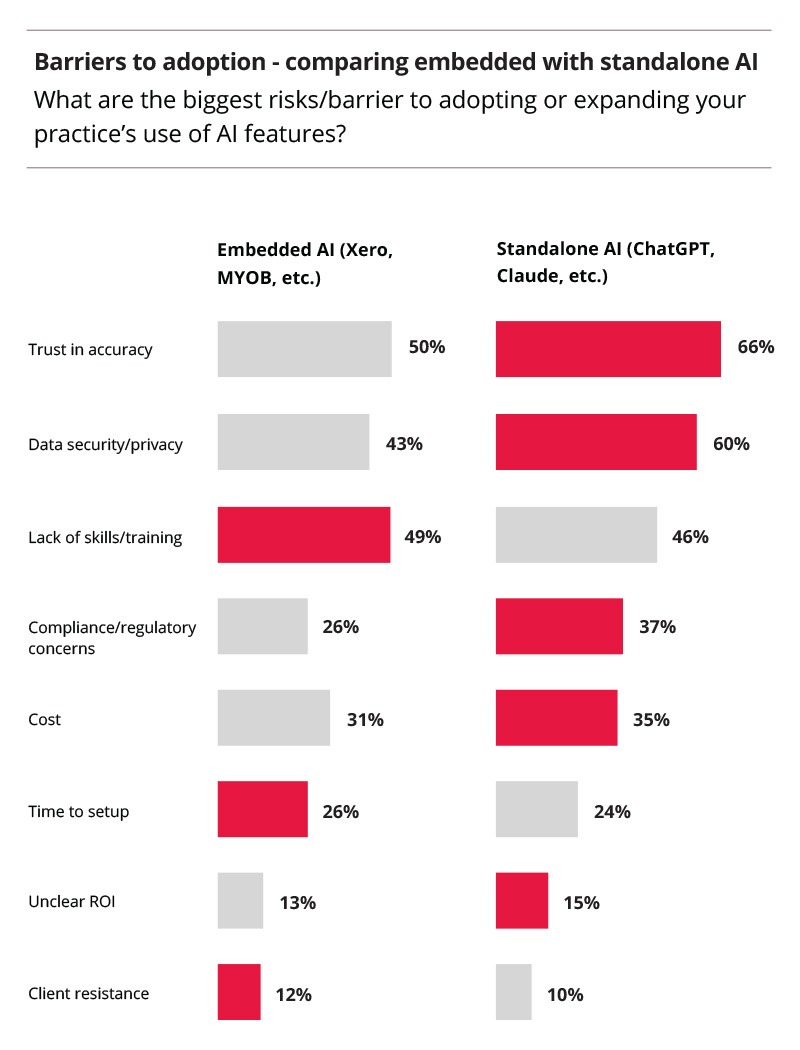
- Accuracy (66% vs 50%) and data security (60% vs 43%) concerns are significantly higher for standalone AI than embedded AI.
- Almost half (49%) of firms cite lack of skills and training as adoption bottlenecks for embedded AI.
- Less than 2 in 10 (13%-15%) are concerned with ROI in implementing AI.
Accountants trust embedded AI tools more than standalone tools
- 2 in 3 (66%) firms perceive ‘trust in accuracy’ as a significant barrier to adopting standalone AI tools, followed by data privacy and security concerns, cited by 60%.
- For embedded AI, half of firms (49%-50%) cited accuracy issues and lack of skills and training as some of the biggest barriers for implementation.
- Only 13% and 15% of firms perceive unclear ROI as a risk for integrating standalone and embedded AI tools, respectively.
Trust in the accuracy of outputs dominates firms’ concerns for adopting both embedded (50%) and standalone AI (66%). The higher number of firms sceptical toward standalone tools, such as generative AI tools Copilot, Gemini or ChatGPT, reflects unease with systems that sit outside established accounting platforms and workflows.
A similar pattern emerges around security and data privacy. Significantly more accountants are concerned with standalone AI (60%) compared to AI embedded within existing platforms (43%). The barrier is lower for the latter, as these systems already manage sensitive client information under strict confidentiality obligations. It also follows that more firms highlight compliance and regulatory risks for standalone AI (37%) than for embedded AI (26%).
As trust in embedded environments is relatively stronger, the primary barrier shifts toward practitioners themselves rather than technology. Training and skills gaps are cited more often for embedded AI (49%) than for standalone tools (46%).
“Accountants are far more comfortable with AI when it operates within platforms they already work with,” says Michael Johnson, Director at Agile Market Intelligence.
“The technology isn’t necessarily the issue but rather the confidence in how new AI features fit into existing systems and standards.”
Lastly, the low emphasis on ROI for both embedded (13%) and standalone (15%) AI tools signals a paradigm shift for the industry. AI is increasingly viewed as a strategic capability rather than a discretionary investment that needs extensive financial justification.
“What’s interesting is that the conversation has moved from questioning the value of AI to whether firms have the skills and support they need to use it well, ” Johnson notes.
Personal experience shapes perceived AI risks
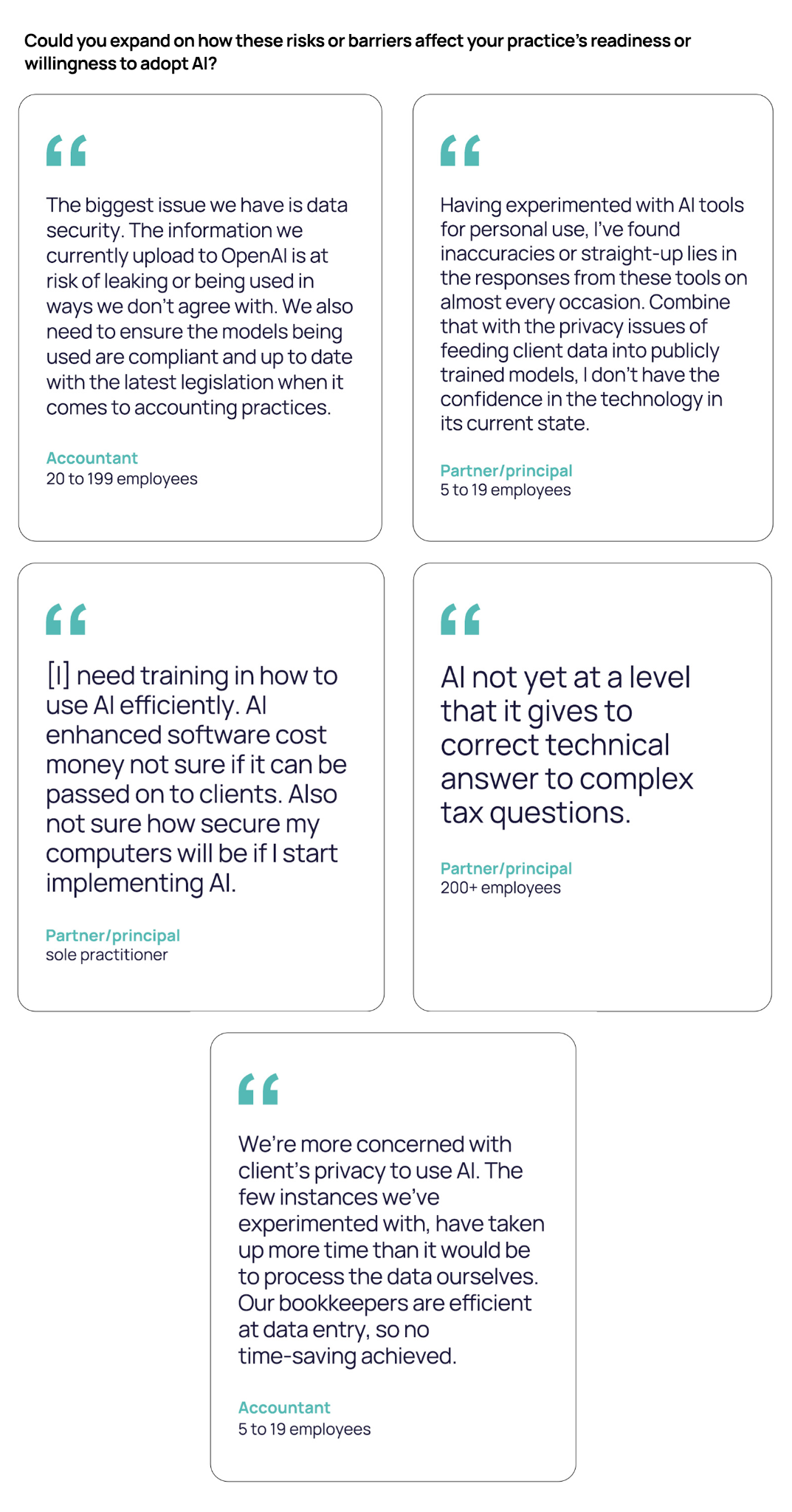
- Accountants point to past experiences with AI producing inaccurate or inconsistent responses as a source of mistrust.
- Firms remain cautious about sharing client information when AI data handling and security protocols are not fully understood by teams.
First hand exposure to AI errors has a lasting impact on professional confidence, with one partner at a large firm saying that “AI is not yet at a level where it consistently delivers correct technical answers to complex tax questions.” As a result, accountants often need to double-check AI outputs and invest time in setup, training, and implementation, which can offset the anticipated time-saving benefits.
At the same time, limited understanding of how AI systems store, process, and share data heightens perceived risk with many accountants voicing concerns on whether using AI would breach privacy laws and Tax Practitioners Board (TPB) regulations.
“Without clear insight into how AI maintains accuracy, protects data, and meets regulatory requirements, firms tend to proceed cautiously, particularly when client confidentiality is involved.”
About the research
The Access Group’s State of AI in Accounting Report 2026, conducted by Agile Market Intelligence, maps out AI adoption, risks and barriers holding back adoption, and the practical use cases already delivering value today. The report captures the sentiments of 434 accountants, bookkeepers and other accounting professionals across Australia around their experiences of artificial intelligence in their practice. Responses were collected between the 9th of September and the 13th of October 2025.
You can download the report here.
